

You can watch the finished worksheets stack up week after week, and that reassuring pile is the only thing you are reliably buying. But the most important work often looks like nothing at all: a tutor sitting with one child, watching how they think and figuring out where they are getting stuck. When one tutor is juggling five students, that kind of attention is usually the first thing to disappear.
More math was never what these kids were missing. The worksheet doesn’t know your daughter can multiply cleanly and freezes the second the numbers hide inside a paragraph, so it keeps moving, and so does she, and the two never meet.
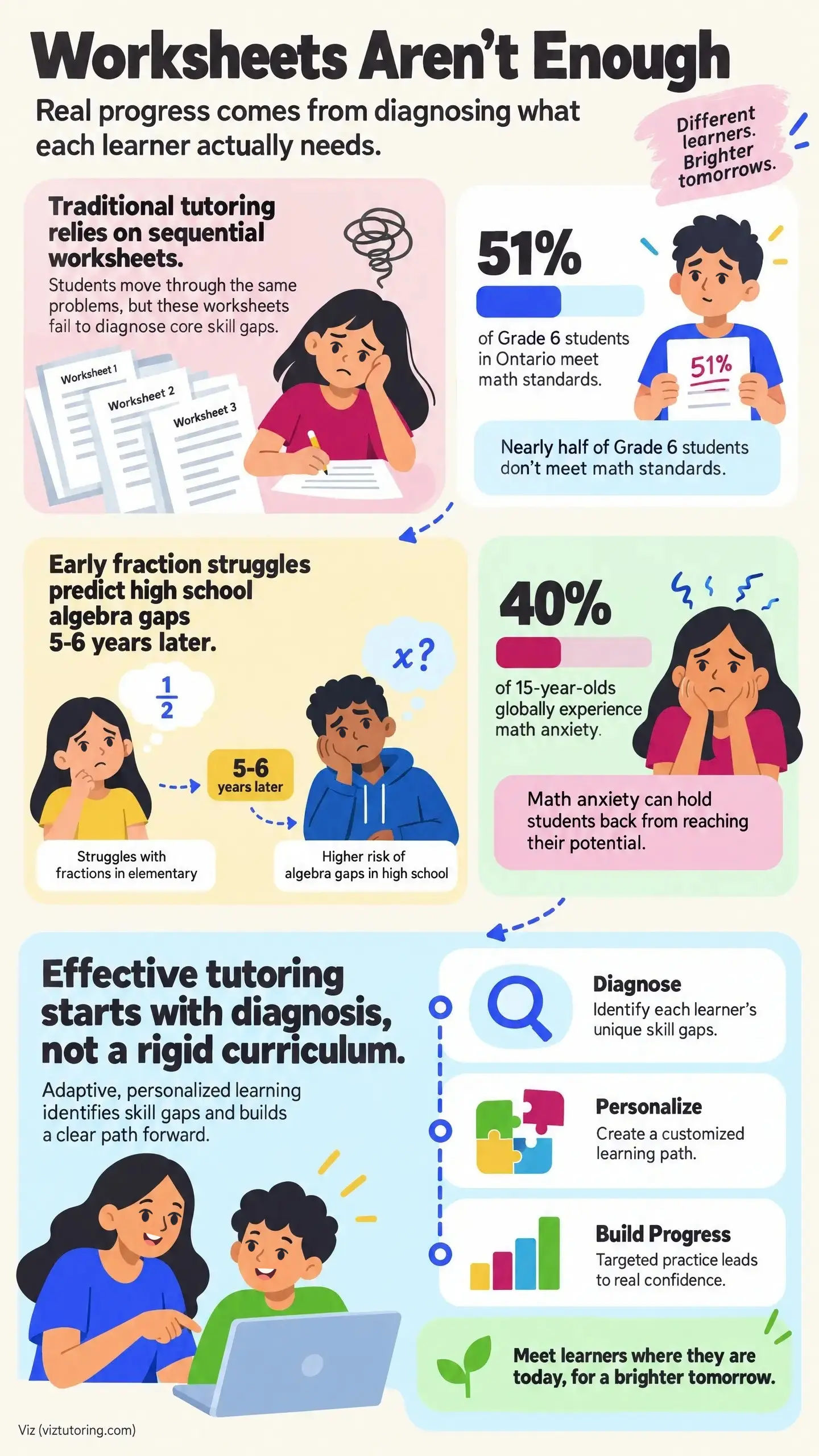
Only 51% of Grade 6 students in Ontario’s English-language schools met the provincial math standard in 2024-2025, and plenty of them have had a tutor for years. The hours were never the problem.
Key Takeaways
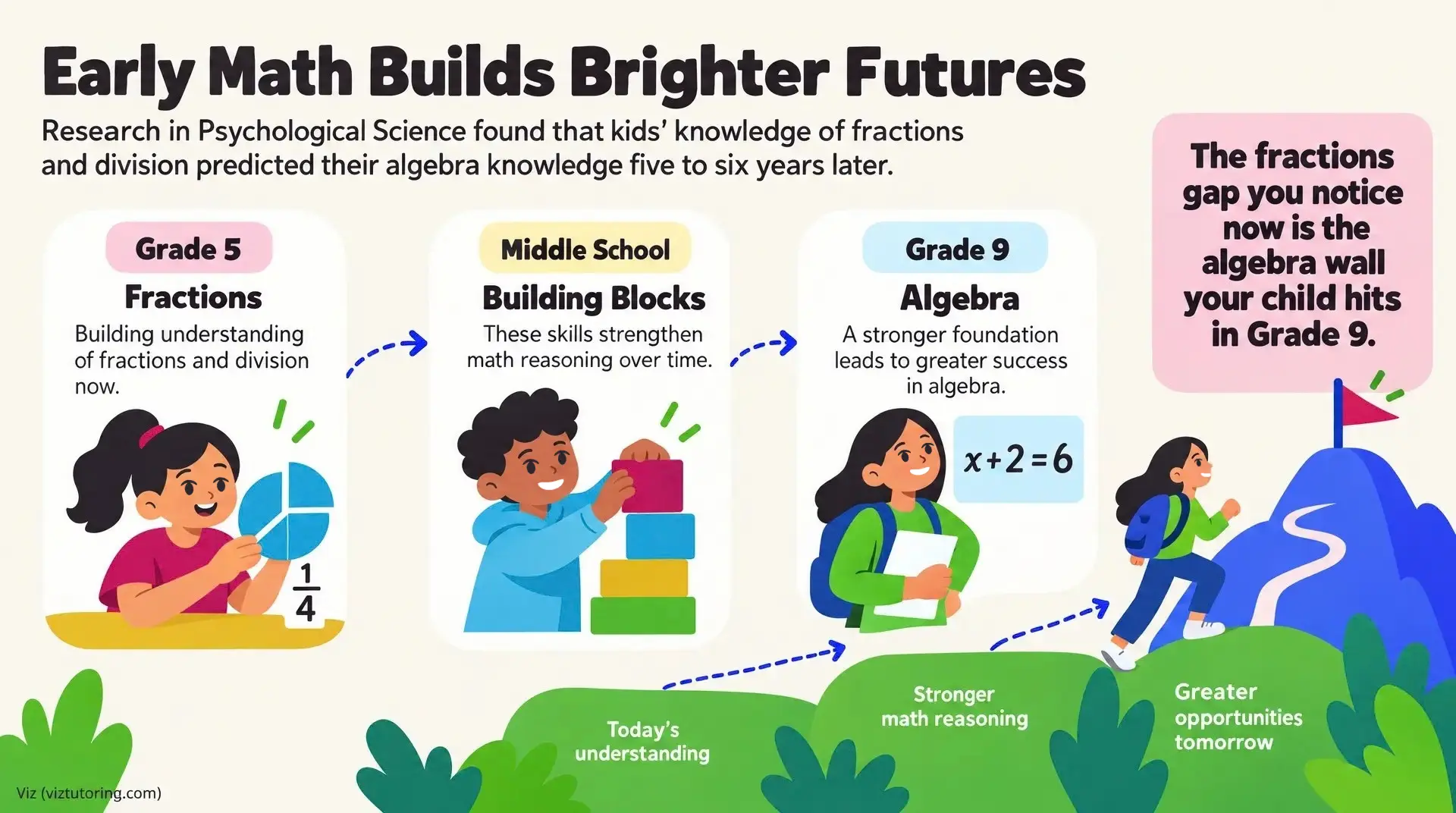
- A study in Psychological Science demonstrated that a student’s proficiency with fractions and division predicts their high school algebra knowledge five to six years later.
- Math anxiety causes a student’s performance to fluctuate unpredictably across days, whereas a genuine mathematical skill gap produces the exact same pattern of errors consistently.
- Ontario student assessment data indicates that only 51% of Grade 6 students in English-language schools met the provincial mathematics standard in 2024-2025.
- Sequential math worksheets fail to diagnose foundational skill gaps because they automatically advance the curriculum without identifying why a student struggles to translate paragraphs into equations.
Why Do Sequential Math Worksheets Fail to Diagnose Student Skill Gaps?
When I say a traditional tutoring center, I mean a place that runs on sequential worksheets or workbooks. Finish one, move to the next. It looks productive, and I understand why parents like it. You can see the pages.
But the worksheet has no idea what happened in your daughter’s math class on Tuesday. It doesn’t know she can multiply perfectly well and freezes the second the numbers are hidden inside a paragraph. It just keeps going. So does she. The two of them never meet.
More math was never what these students needed. Somebody has to figure out where the disconnect is happening, and that is a completely different job than handing over the next page. In a rigid center, the curriculum becomes the priority instead of the student. Once that happens, a child can spend months being tutored while nobody is solving the thing that’s making them struggle.
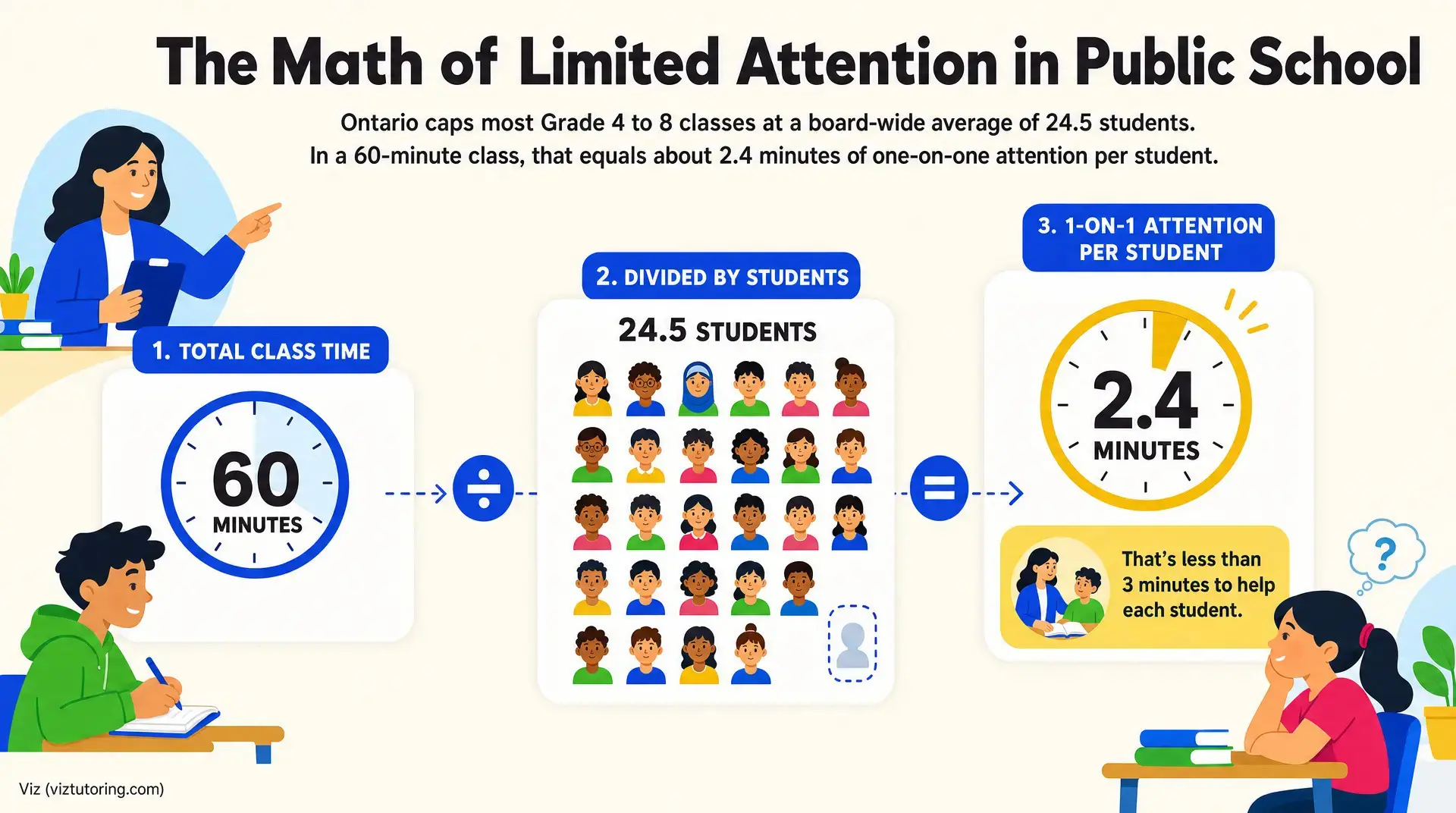
I don’t blame the people working inside those centers. Most of them care about kids. It’s a limitation of the model, the same one I left the classroom over. Put 25 or 30 kids in an hour-long class and you get roughly two minutes per student, and that’s if you skip the lesson entirely. Many centers recreate a smaller version of that room, one tutor and a table of four or five kids. Researchers at the Annenberg Institute put the limit at three or four students at a time before tutoring turns into small-group instruction. Diagnosis is the first thing dropped when attention is split, because diagnosis means sitting and watching one child think.
What Are the Limitations of Scripted Direct Instruction in Math Tutoring?

About 10 years ago I worked for a different tutoring company that used a method called direct instruction. There were lettered levels, A through D as I remember it, and you read the lesson word for word off the page. You said the formula. The student repeated it back. You plugged in the numbers.
I want to be fair here. A 2018 review of 328 studies going back to 1966 found positive effects for Direct Instruction curricula, so I won’t argue the whole approach is bad. What I saw in that job was the stripped-down version, all procedure and no diagnosis. Nobody was allowed to ask why, and nobody checked whether the kid understood anything beyond the script.
It reminded me of my own Grade 9 math teacher. He was dry, but everyone did well in his class, because during tests he’d walk the aisles, point at a spot in a question, and ask, “Are you sure?” I left that year knowing tricks for specific problems and not much more math than when I walked in. That’s the best case for rigid tutoring. A decent grade this term, built on nothing your child will still have in Grade 11.
Why Do Students Struggle to Translate Math Word Problems Into Algebraic Equations?
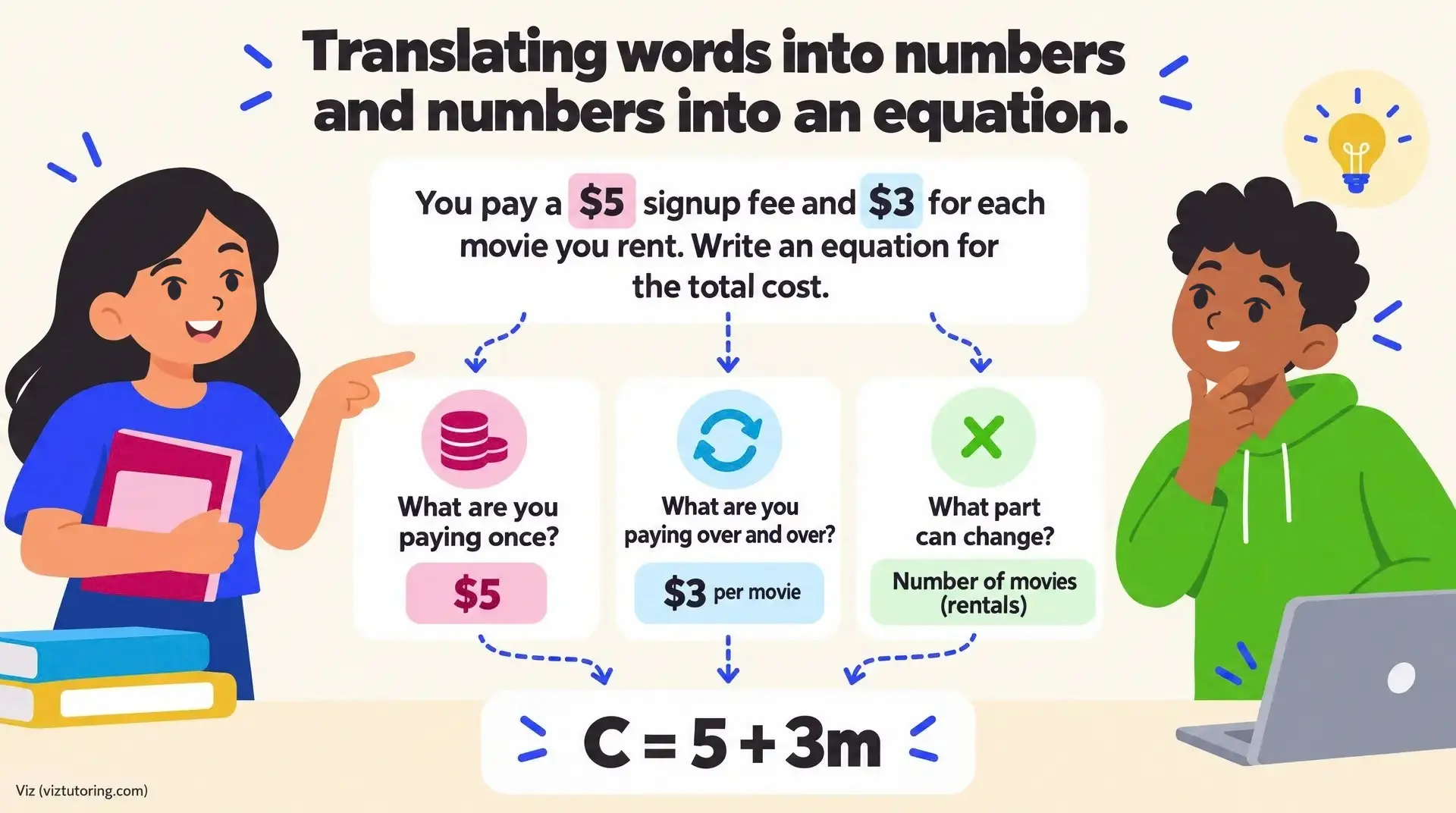
A student I worked with opened her workbook and, before I’d really said hello, told me, “I don’t get this. I’m terrible at word problems. I hate word problems.” The question described a service that charged a one-time setup fee plus a monthly amount, and she had to turn it into an equation.
So I pulled the math apart and asked her each piece on its own. Could she multiply? Yes. Did she understand what a variable was? Yes. Addition, yes. Every skill she needed was sitting right there. Then I put those same pieces back inside the paragraph, and she froze.
We stopped the worksheet. I told her to forget the equation for a minute and just tell me what was happening in the story. Then I asked three questions. What are you paying once? What are you paying over and over? What part can change? She answered all three without hesitating. We wrote them down as short sentences with the numbers in them, and suddenly the equation was right there on the page.
She knew the algebra. What she couldn’t do still was translate words into numbers and numbers into an equation. If I’d kept moving through a predetermined algebra lesson, we would have spent 55 minutes practicing something she already understood, and she’d have gone home still hating word problems.
A good tutor should be able to change direction five minutes into a session. If a kid logs on and says, “I understood this yesterday, but today my teacher introduced something new and I’m lost,” then that becomes the lesson. You shouldn’t have to wait until the tutoring program catches up to your child.
Why Do Elementary Math Fraction Struggles Predict Future High School Algebra Gaps?
Parents tell me this constantly, and I never tell them they’re wrong. Their child really is struggling with fractions. But from four years of teaching Grade 5, I can tell you fractions was very often the point where the problem became visible, even though it wasn’t the original problem.
Fractions lean on multiplication, division, factors, and multiples. A student who can’t find a common denominator may simply not know her multiples. A student who can’t simplify may not be able to divide. A kid can shade in one half and three quarters perfectly and still have no idea what one and a half means. A program pointed at Grade 5 fractions will keep handing that kid fraction worksheets. It can’t see underneath.
Research in Psychological Science found that kids’ knowledge of fractions and division predicted their algebra knowledge five to six years later, even after accounting for IQ and family income. The fractions gap you notice now is the algebra wall your child hits in Grade 9.
One student I worked with had just moved to Toronto from New York. She was in Grade 5, and homework had turned into full meltdowns with her parents. When I actually watched her work, she was still counting on her fingers for facts that should have been automatic by then. So I put the Grade 5 material away. We went back to manipulatives, concrete pieces you can move around and count, and rebuilt the basics in small steps. Over time she got more independent and more confident, and she needed less and less of me.
A child can work around a gap like that for months, and by the time an adult notices the anxiety, the two are feeding each other. Sometimes the fastest way forward is to go backwards for a few minutes. A fixed sequence has no mechanism for that decision. Nobody there is asking what this assignment assumes my child already knows.
How Can Parents Differentiate Between Math Anxiety and Skill Gaps During Homework?
The nightly homework fight is usually what pushes a parent to finally call someone. In that moment your child is being evaluated by the person whose approval matters most, and the stress of that eats up the exact mental space they need to do the problem. Their brain is treating the situation as a threat, and your corrections land as criticism instead of information.
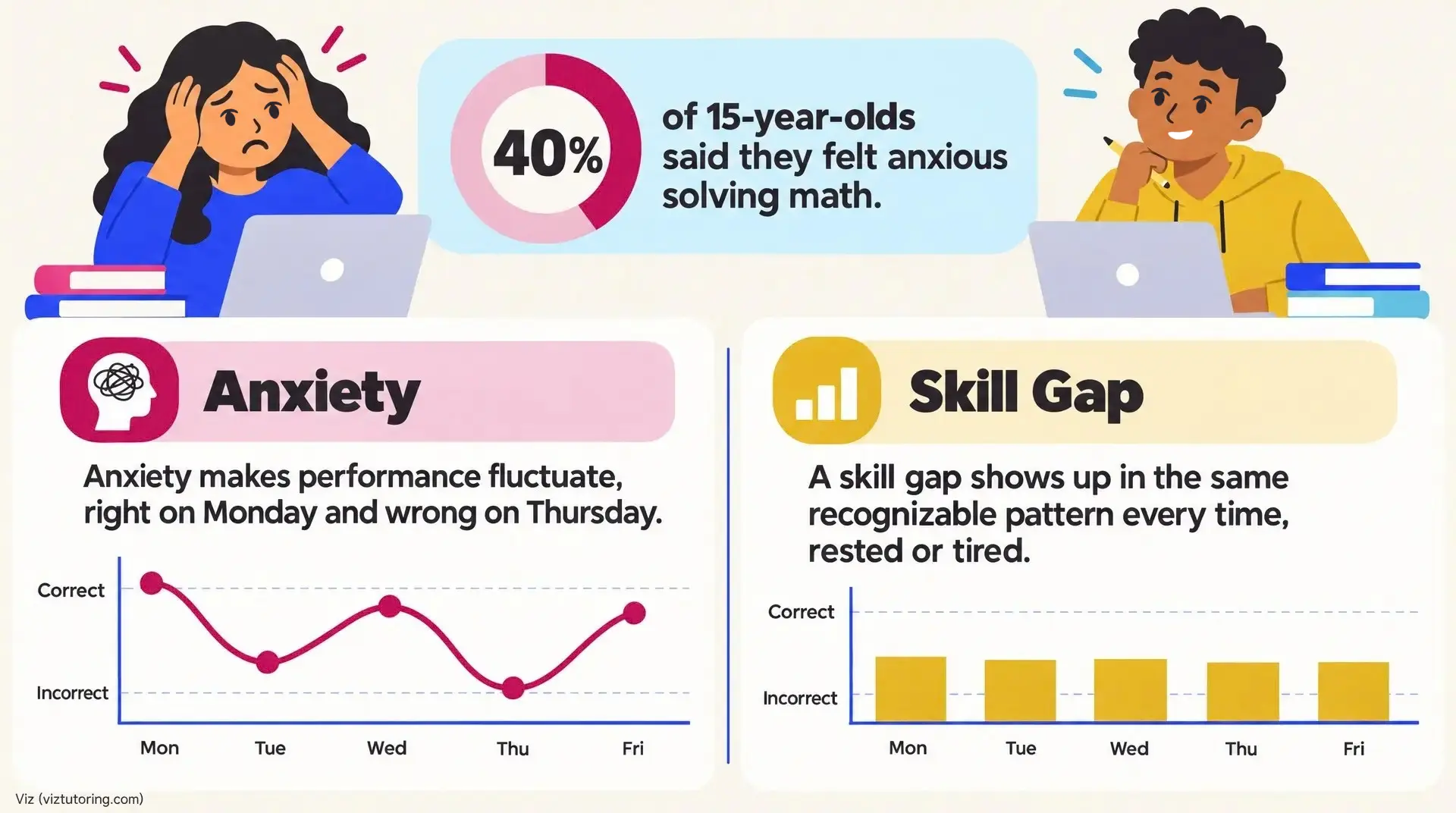
This is a huge group of kids. Across OECD countries, about 40% of 15-year-olds said they felt nervous, helpless, or anxious while solving math problems or doing math homework. Closer to home, Ontario’s own student survey found only 48% of Grade 6 students like math and only 50% think they’re good at it. Half the Grade 6 kids in this province already doubt they’re any good at it.
So when a parent says “you just need to try harder,” to be honest, I understand the impulse. I felt it in the classroom too. But most of the kids I see are already trying really, really hard, and telling them to persist just repeats the same message in different words. Sometimes the most growth-minded thing a child can do is stop using a strategy that isn’t working and ask for help.
Anxiety and a skill gap also sound identical from the outside. I tell them apart by removing pressure and changing one thing at a time. Anxiety makes performance fluctuate, right on Monday and wrong on Thursday. A skill gap shows up in the same recognizable pattern every time, rested or tired. And sometimes it’s neither. I had a Grade 8 student who did badly on an early quiz, and it would have been easy to assume the unit needed re-teaching. When I sat with her, she knew the material. What she’d built up was a habit of needing an adult to confirm each step before she’d start. So the job became weaning her off that, one problem at a time, until she trusted her own first move. No worksheet sequence would have caught it, because on paper it looks exactly like a math problem.
Tutoring Should Fit the Student, Not the System

The process around traditional tutoring is its own kind of broken, too. You call a few companies, talk to an administrator who may never have tutored anyone, commit to a package or a subscription, and hope. Then your kid gets strep on a Wednesday and you’re paying for Wednesday anyway. If the tutor turns out to be a poor fit, most families are stuck with them, and a lot of them quit tutoring altogether. I built Viz around every one of those failures.
We don’t use a preset curriculum. Tutors work from whatever your child is doing at school this week, and they’re trained to throw out a planned lesson in the first five minutes if a kid shows up confused by something new. They don’t correct a wrong answer right away, either. They have the student talk through it out loud, because a careless slip and a real gap sound completely different when a child explains their thinking. And they sit through a 20- or 30-second silence before jumping in, because that pause is where a lot of the learning happens.
Nobody on my team asks “Do you understand?” Kids almost always say yes, either to avoid embarrassment or because watching someone do the steps feels like understanding. I learned that from an algebra student who nodded along perfectly and then froze the moment I handed over an independent problem. So we ask, “Tell me what you think you should do first, and why.” The answer shows you exactly where the thinking breaks.
On matching, parents usually weight the tutor’s credential level heavily and shared interests barely at all. In my experience that’s backwards. Shared interests build trust in the first session and let a tutor write a word problem about a girl’s gymnastics routine instead of pulling a generic one from a textbook. If the match isn’t right, you re-match for free. There are no packages either. Book one 55-minute session or 20, on-demand tonight or the same tutor every Tuesday. Every session is recorded so your child can re-watch what they forgot, and pricing runs from approximately $50 to $85 depending on the tutor’s level, a range I set so more families could afford a real person.
How Can Parents Use Homework Friction to Identify Math Skill Gaps?
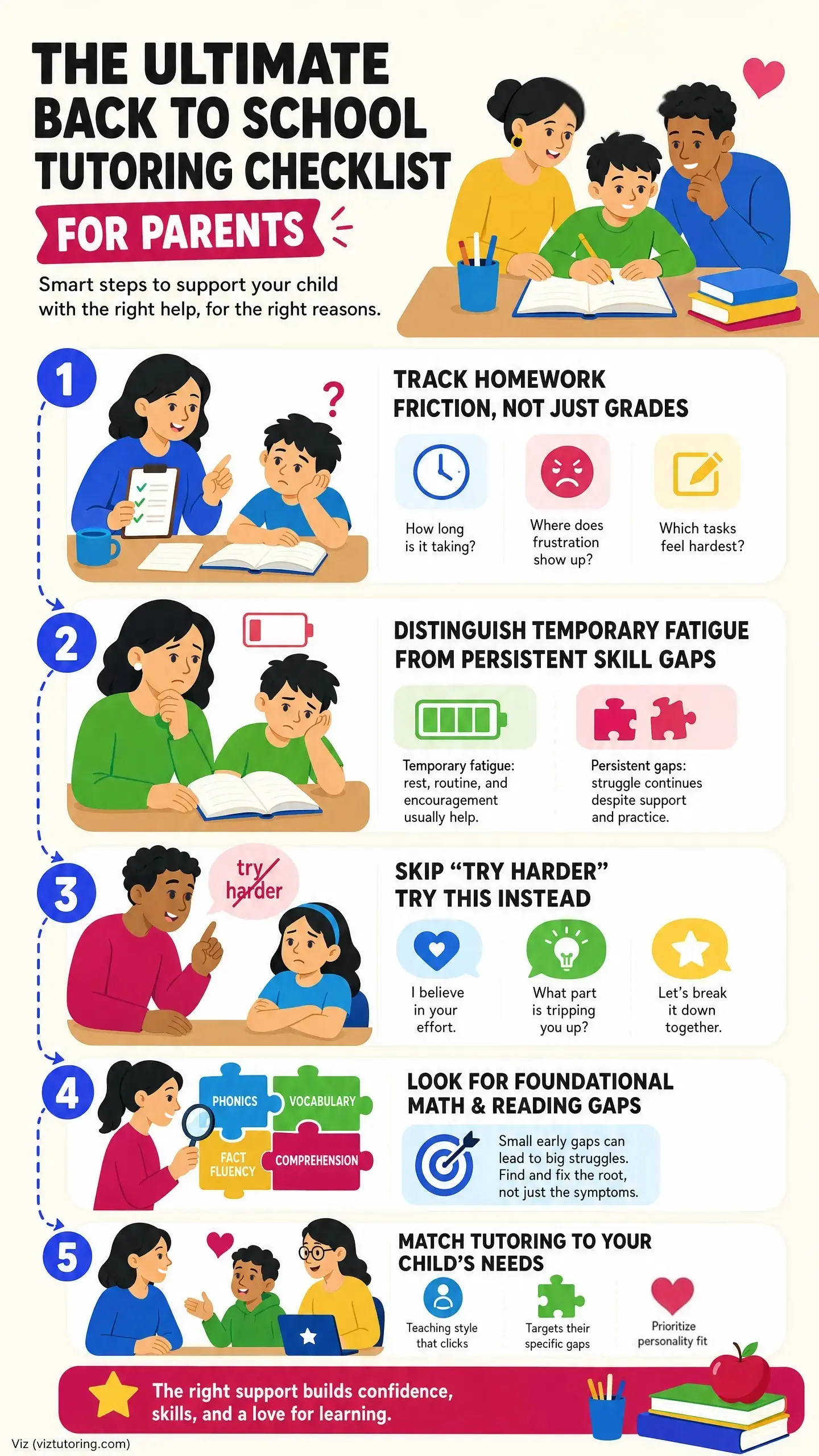
You don’t need a diagnostic test to know whether your child’s tutoring is working. Track friction instead of grades. Where do they slow down? What do they ask for help with over and over? What can’t they finish without an adult in the chair next to them? A homework fight that keeps landing on the same subject, or a 20-minute assignment that stretches to an hour is a gap signal, and a worksheet sequence will roll right past it.
Then ask whoever is tutoring your child one question after the next session: “What did you learn about why my kid is stuck?” If the answer is “we finished the next worksheet,” you have your answer too.
A failing grade tells you the outcome. It never tells you the cause. Your child deserves someone whose whole job is finding the cause.
Frequently Asked Questions
How many days a week does my child need after-school tutoring to catch up?
High-impact tutoring requires consistency. According to the Annenberg Institute, tutoring is most effective when delivered at least three times a week. However, the goal isn’t logging hours. You want targeted sessions that diagnose the actual gap rather than exhausting your child with endless worksheets.
Is it better to seek in-school support instead of after-school tutoring?
If your school offers it, use it. A meta-analysis of 96 studies found in-school tutoring often outperforms after-school models. But school resources are stretched thin. If their teacher can’t sit and watch your child think one-on-one, a flexible after-school human tutor becomes your safest bet.
How quickly will my child’s grades improve with an after-school tutor?
Grades are lagging indicators. Nationally, the average U.S. student remains half a grade level behind pre-pandemic benchmarks. Don’t expect failing grades to vanish overnight. Watch for reduced homework friction first. When the nightly meltdowns stop, the test scores eventually follow.
How do we schedule after-school tutoring if my child is already burnt out?
You drop the rigid center model. Forcing an exhausted kid into a car to go complete generic workbooks guarantees a fight. Instead, use flexible, on-demand home sessions. A skilled tutor pivots the lesson to whatever your child can handle that evening, repairing confidence without adding travel stress.
What is the best way to handle last-minute homework panic the night before a test?
Stop drilling. OECD data shows 65% of students worry about poor math marks. Pushing harder just spikes anxiety. Book a flexible, on-demand session to diagnose the specific disconnect. A calm human conversation does far more than cramming rigid procedures they do not actually understand.