

A failing math grade can often describes the size of the classroom far more accurately than it describes the child sitting in it.
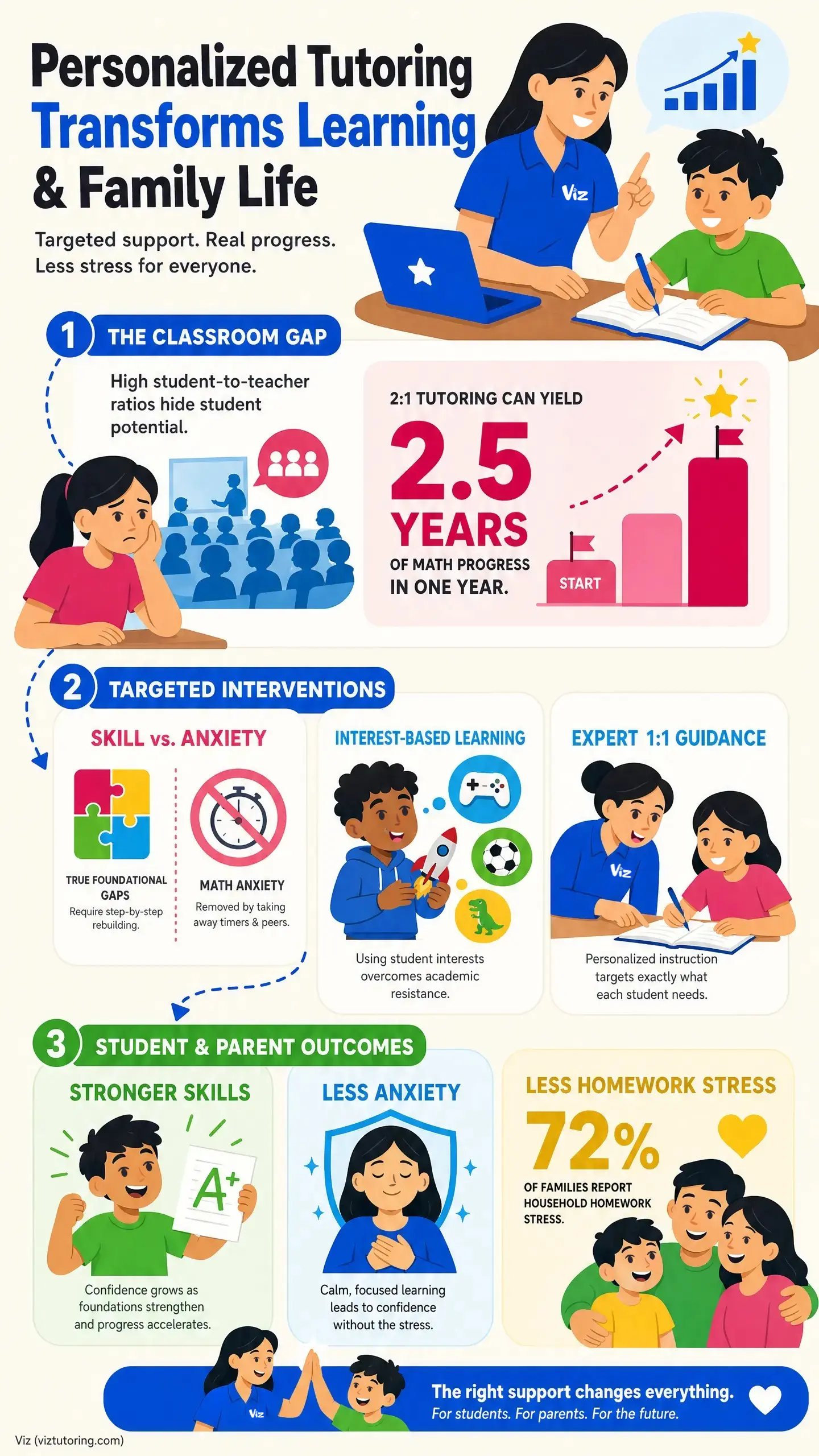
Chicago researchers took kids the system had already written off, narrowed the ratio to two children per adult, and saw them advance two and a half years in math in just one year. The capability everyone thought was missing was simply trapped behind a single teacher’s hour, divided 30 ways into two minutes each.
No teacher reaches a child in two minutes, which means the grade on your fridge was never a verdict on your kid at all.
Key Takeaways
- Changing the instructional ratio to two students per adult enabled Chicago students previously labeled as falling behind to gain two and a half years of math proficiency in a single year.
- Elementary school proficiency in fractions and division uniquely predicts algebra achievement five to six years later, regardless of a student’s intelligence, memory, and family income.
- The PISA 2022 results demonstrated that every one-point increase in a student’s math anxiety correlates with an 18-point drop in math scores, independent of family background.
- Tutors isolate math anxiety from foundational skill gaps by removing timers and breaking questions into smaller steps to test if performance improves when pressure is eliminated.
- Stanford researchers define high-impact academic tutoring as a minimum of three sessions per week spanning over 10 weeks with a consistent tutor.
- Live-online algebraic tutoring effectively improves test outcomes, with research showing that 39% of tutored ninth graders passed their state algebra exam compared to 31% of comparable non-tutored peers.
Why Are Foundational Math Skill Gaps the True Cause of Poor Academic Performance?
The most common opening line I hear is, “My kid needs help with fractions.” And the parent is right about what they’re seeing. But after four years of teaching Grade 5, I can tell you fractions was a lot of the time the point where the problem became visible, even though it wasn’t where the problem started.
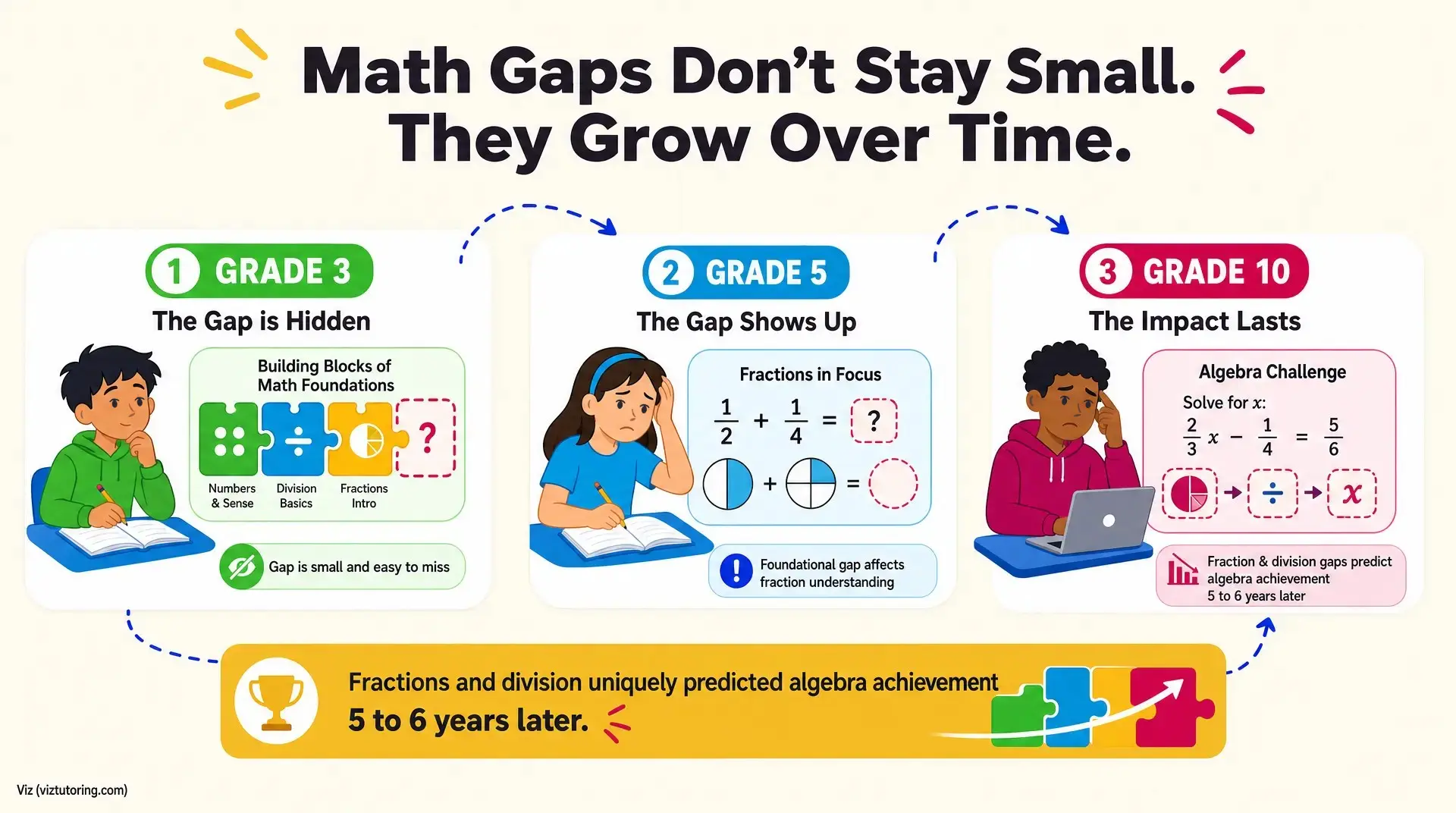
Look at what fractions actually demand. Finding a common denominator means knowing your multiples. Simplifying means division. Equivalent fractions lean on multiplication. A kid can shade in one half all day long. Ask them about one and a half, and the Grade 3 gap they’ve been carrying finally has nowhere to hide.
This matters more than most families realize. Researchers who tracked thousands of students found that fractions and division skills in elementary school uniquely predicted algebra achievement five to six years later, even after accounting for intelligence, memory, and family income. Tonight’s fractions fight is quietly a fight about Grade 10 math.
And I want to be blunt about something: these gaps do not close on their own inside a classroom. Ontario’s latest EQAO results show 49% of Grade 6 students missed the provincial math standard, and when the same children were tracked from Grade 3 through Grade 6, 33% never met the standard in either grade. Four years of school. Same gap. The class kept moving and the gap sat still.
De-streaming made the room even harder to teach. In 2021, Ontario collapsed three separate Grade 9 math pathways into one course. I understand the intention behind it. But one teacher now faces an even wider spread of foundations in a single room, with the same hour to spend.
So here’s how I actually start with a failing Grade 8 student. I don’t open with a Grade 8 test. I quietly work at Grade 6 and 7 material, because a failing grade might tell me the outcome, but not the cause. And I don’t correct wrong answers. I walk through them with the student to find where the gap begins. Correcting teaches nothing, and it costs the kid a little more confidence every time.
How Can Tutors Differentiate Between Math Anxiety and True Foundational Skill Gaps?
These two problems look identical on a report card, and they need opposite treatments. I tell them apart by changing one thing at a time.
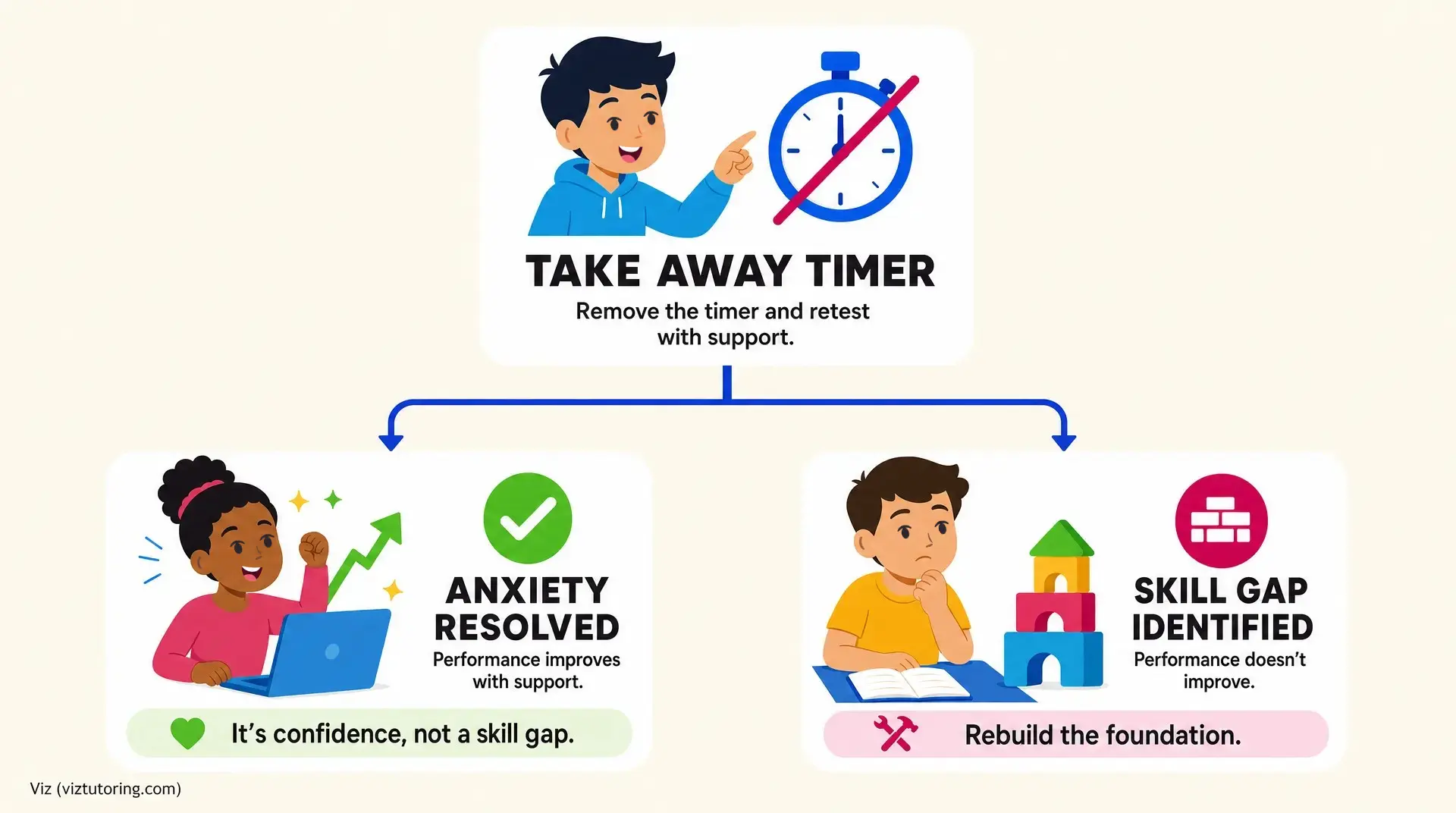
Take away the timer. Break the question into smaller steps. Hand the student the first step and watch. If the support changes the result, I’m looking at confidence. From what I’ve seen, a student who presents a lack of confidence often knows much more than they initially show. Their marks and their knowledge simply don’t match.
The anxiety piece is measurable, by the way. In PISA 2022, each one-point rise in a student’s math anxiety lined up with an 18-point drop in math scores, even after accounting for family background. I’ve watched that play out on my own screen. A kid bombs a test on Tuesday, then solves nearly identical questions with me on Thursday once the timer and the room full of classmates are gone.
A true skill gap behaves differently. I can prompt and reassure all session long and the performance doesn’t move, because the knowledge genuinely isn’t there. I don’t want students believing their effort alone can solve everything. Sometimes we go back two grade levels and rebuild. My method there is simple: I solve a question fully myself, then we do one together, then the student does one alone. It’s tedious sometimes, but it works.
Through all of it, I deliberately hold back. If I give a student too much help, that can actually make them think they can’t do it alone. And if I jump in too quickly, the problem gets solved, but the student doesn’t gain that understanding.
I learned that last part as a student myself. My Grade 9 math teacher used to walk the aisles during tests, point at the exact spot where you went wrong, and murmur, “Are you sure?” Everyone in that class got good marks. I left knowing tricks for his specific questions and not one bit more math. Grades went up while understanding stood still, and a tutor can absolutely become a nicer version of that teacher – hovering, hinting, fixing. When you’re evaluating a tutor, that’s the failure mode to watch for.
One more thing about the trap these kids sit in. The skill gap creates the confidence problem, and the low confidence stops the practice that would close the gap. Somebody has to break that loop from the outside. Extra worksheets never do.
How Do Tutors Use Student Interests to Overcome Academic Skill Gaps?

A parent once told me her daughter just needed to try harder at math. The girl was in Grade 5, and I could see she was already trying very hard. She just really didn’t like math, because nothing on the page connected to her life. She was into gymnastics, so I built the word problems around gymnastics and made everything visual – dots on the screen, virtual manipulatives she could drag around. It made a big difference. And as much as students hate word problems, word problems really help with fractions, because kids finally watch the four basic operations behave in the real world.
Same thing happens with writing. A Grade 4 boy told me flat out he wasn’t a writer. He loved hockey, so I gave him an assignment called “a day in the life of a hockey puck.” He wrote about the puck’s feelings during a slap shot, the roar of the crowd, getting stolen from one team by the other. Parts of it genuinely made me laugh. He stopped fighting writing because the writing was finally about something he loved.
When a kid says “I’m just not a math person,” I don’t argue with the belief. I change the material until the belief stops matching the evidence.
How Does Academic Tutoring Reduce Parent Stress and Homework Conflict?
Now for the half nobody prints on a report card.
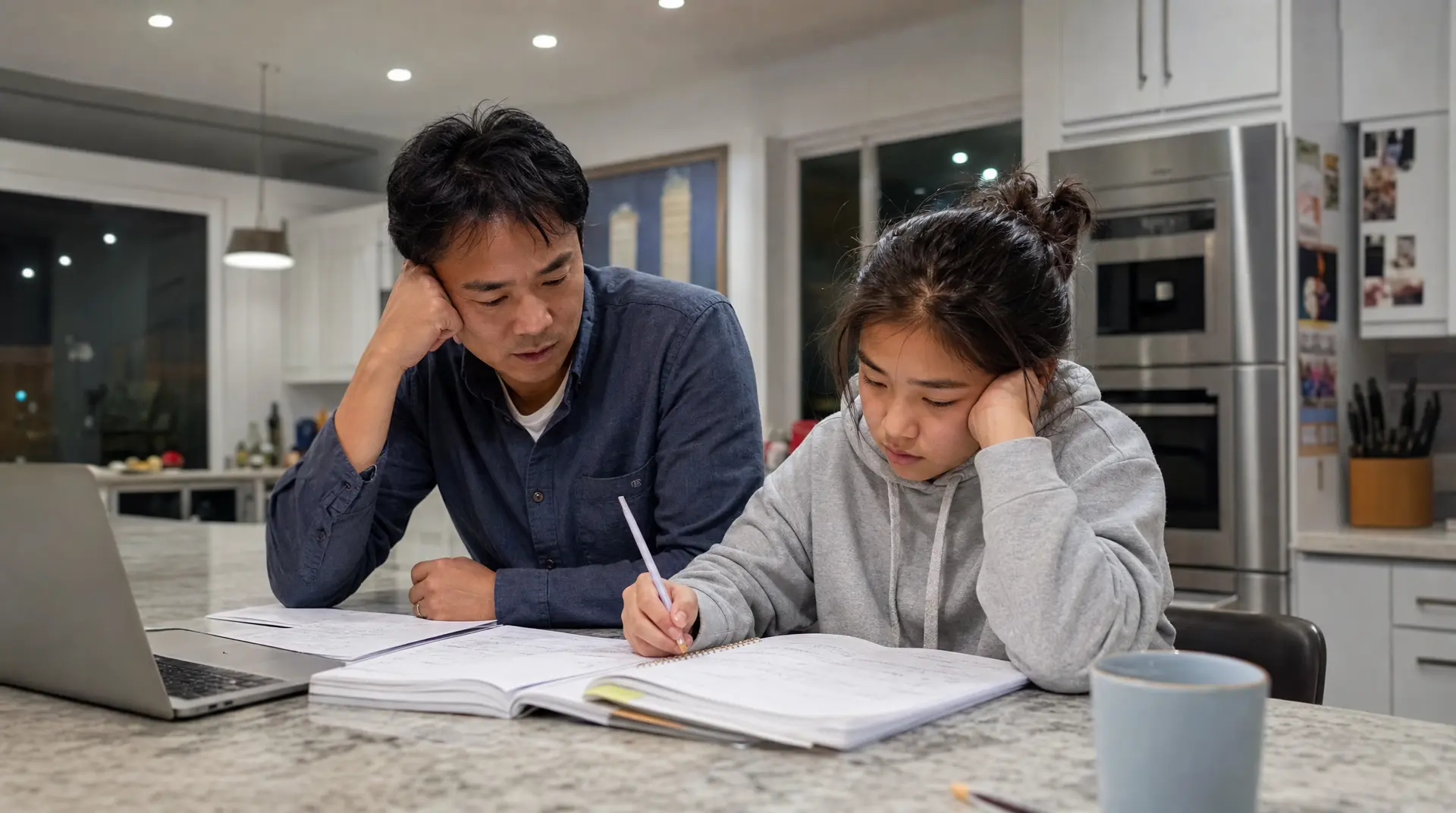
A Statistics Canada survey found that 72% of parents called homework a source of stress in their household, and one in three had hired a tutor at some point. If your evenings are tense, your house is the norm.
I want to name the phrase doing the most quiet damage in those evenings: “You just need to try harder. Just focus.” I say this gently, because as a teacher I sometimes felt like saying it too. But most struggling kids I sit down with are already trying really, really hard. Telling a student to persist and keep trying, sometimes that’s not true support – it’s just “try harder,” phrased differently. Even “growth mindset” gets used this way now. Kids tell me they’ve come to hate the term, because adults reach for it as a dressier way of blaming them for struggling.
Swap the phrase. Try, “Show me where you started to feel lost.” The first demands more output from a kid who has none left. The second starts a diagnosis.
And sometimes the diagnosis has nothing to do with math at all. I’ve seen kids who couldn’t focus at home because the space was too quiet, and kids who couldn’t focus because siblings were everywhere. Parents rarely look there, because they’re staring at the worksheet.
Which brings me to the relief parents never expect: you get to stop playing detective. You’ve been out of a classroom for 20 years, the methods changed, the course codes changed, and you’re exhausted from work – still somehow you’re supposed to be the math expert and the homework enforcer. When a kid comes to me burned out from fighting with their parents over math, I start with something simple so they get questions right, go simpler if I have to, and only raise the difficulty once the wins are real. In my experience, the fighting stops at home before the grades move. That order surprises people.
What Are the Limitations and Benefits of Emergency On-Demand Academic Tutoring?

You know this night. Your kid remembers the test at 9 p.m., or reaches question 12 of an assignment and realizes he misunderstood the whole thing. Frustration peaks at the exact moment help is least available, and that’s usually when the fight starts. It’s why Viz runs on-demand sessions bookable within 24 hours.
Skeptics have asked me whether last-minute tutoring is just monetized panic, so let me give you the honest accounting. Fifty-five minutes the night before can find the most important gaps, fix one or two misconceptions, calm the student down, and leave targeted practice for after. It cannot replace a missed semester. Stanford’s tutoring researchers define high-impact tutoring as three or more sessions a week over 10-plus weeks with a consistent tutor. One emergency session is triage, and I’ll say that to any parent who asks.
But triage at the right moment is worth a lot. The help lands while the student is actually stuck, and the kitchen fight simply never happens. Afterward, the session recording stays available for 90 days so your kid can rewatch the exact explanation before the test, and you get feedback after every session instead of interrogating a 12-year-old about what got covered.
Why Does High-Dosage One-on-One Tutoring Improve Academic Grades More Than Worksheets?
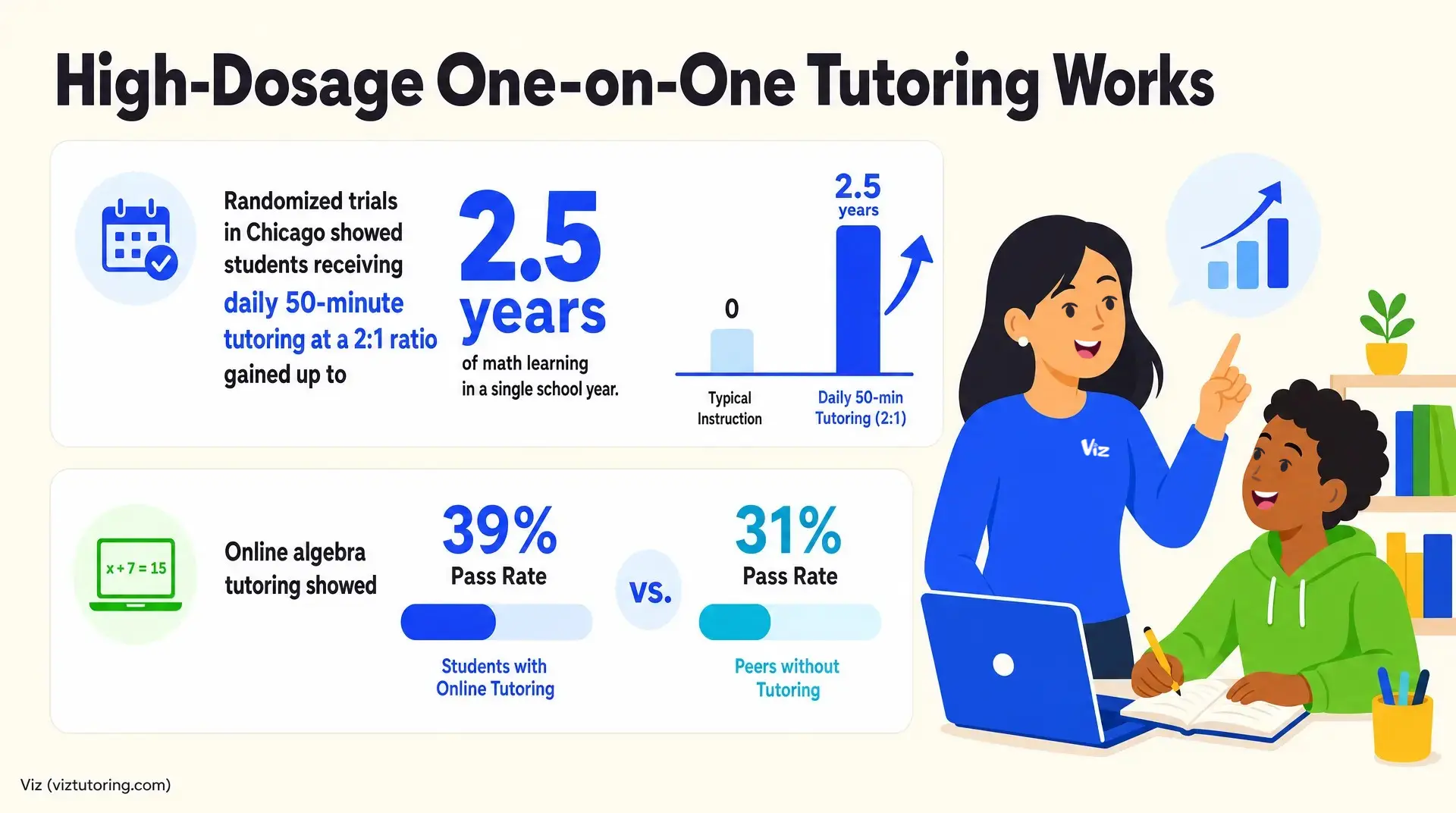
The ratio is what’s doing the work. In randomized trials in Chicago, students who received daily 50-minute tutoring at a two-to-one ratio gained up to two and a half years of math learning in a single school year. These were kids the system had already labeled as behind. The only variable that changed was the number of students per adult, and years of supposedly missing ability showed up.
Live online delivery holds up too. In a recent study of live-online algebra tutoring, tutored ninth graders passed the state algebra exam at 39% versus 31% for comparable peers. I mention it because parents still ask me whether online counts as real tutoring. From my side of the whiteboard, watching how a student hesitates over a shared screen tells me things a submitted worksheet never will.
Then there’s the match, which matters differently than parents assume. Families consistently overestimate a tutor’s credential level and underestimate shared interests. Viz‘s matching algorithm weighs 11 factors, and the one that surprises people most is interests – those gymnastics word problems don’t exist unless the tutor knows about the gymnastics.
Our pricing runs in tiers from approximately $50 to $85 instead of one flat premium rate. And I’ll say this plainly: parents aren’t paying for access to information. Information is everywhere – ChatGPT is patient, Khan Academy is free. You’re paying for a person who notices the hesitation, the misread question, the kid nodding along without understanding. No app flags those.
The person matters so much that I’ve rejected candidates with flawless resumes. Degrees, experience, glowing references – then the mock tutoring session in our interview process shows me they can’t get an idea across or draw anything out of a kid. Personable is my one non-negotiable, and paper can’t prove it. If a match still isn’t right, families can switch tutors anytime at no cost, and you’ll never be paired with an unmatched tutor again.
What Are the Realistic Academic Outcomes and Limitations of Private Tutoring?
I’ll finish honestly, because overselling helps nobody. If your child mostly needs sleep and less pressure, a tutor can help them walk into tests calmer, but the sleep part is out of my hands, and I’d rather tell you that than sell you sessions.
None of this criticizes teachers. The limitation lives in the model they work inside. No amount of funding in a classroom buys a child individualized attention at the exact moment they need it – the moment confusion begins, the moment confidence starts to slip. I was that teacher, with 30 kids and two minutes each, watching gaps form that I could see and couldn’t reach.
What tutoring reliably delivers is someone who catches the misconception the week it forms instead of the year the report card announces it. Someone who runs the skill-versus-confidence test and treats the right problem. And sometimes it’s okay if a student stays behind curriculum for a while, because they need that time to be caught up. A classroom can’t grant that time. A tutor can.
Understanding drives grades, and confidence drives understanding. Report cards capture only half the story, while the rest unfolds on a Tuesday night when homework is simply homework.
Frequently Asked Questions
How long does it take to see the benefits of tutoring?
Meaningful change takes time. While one session offers triage, Stanford researchers note that high-impact tutoring requires sessions of 30-60 minutes, three times a week, for 10-plus weeks. Sustained dosage is what permanently closes gaps.
Can I provide the benefits of tutoring by helping my child myself?
You can help, but the dynamic differs. An NBER analysis found tutoring yields strong learning gains, but effects are significantly higher for professional tutors than parents. An outside expert effectively ends the homework battle.
Should I wait until high school to seek the benefits of tutoring?
No, don’t wait. The NBER found tutoring effects are strongest in early grades. Furthermore, early mastery of fractions and division uniquely predicts algebra achievement 5 to 6 years later. Catching gaps early prevents major high school crises.
Will once-a-week sessions deliver the same academic benefits as intensive tutoring?
Weekly sessions maintain skills but don’t always close deep gaps. In Saga Education trials, students gaining 2.5 years of math learning had daily sessions. Deep deficits demand high-dosage consistency.