

The instinct with a struggling child is always to add support: another example, another hint, the first step laid out for them. That reflex is often what quietly manufactures the failure.
One Grade 8 student of mine did every assignment, but followed the examples at the top of the page and asked ‘is this right?’ at each step before bringing home a 58%. She had mastered every skill on that quiz and could not begin a single problem without a hand to hold.
The quiz removed the example at the top of the page and the voice confirming each move, and what remained was a child who could not start.
Key Takeaways
- During the first three weeks of school, parents should ignore initial grades and track homework friction, such as a 20-minute math assignment stretching to an hour, to identify underlying academic issues.
- Unlike general student fatigue which can affect performance across subjects, academic skill gaps can be subject-specific, reflected in 2024-25 EQAO data showing only 51% of Ontario Grade 6 students meeting the provincial standard in math versus 86% in reading.
- Research tracking students in the United States and the United Kingdom demonstrates that a child’s grasp of fractions and division in elementary school predicts their algebra knowledge five to six years later.
- Asking struggling students if they understand material can be an unreliable metric, evidenced by 2024-25 EQAO data where 64% of Ontario Grade 9 students said they understood most of the math they were taught, but only 58% met the provincial math standard.
- Parental homework correction can be counterproductive when it becomes controlling or increases anxiety, aligning with a 223-study meta-analysis of approximately 400,000 participants showing a clear negative link between math anxiety and math achievement.
Why Should Parents Track Homework Friction Before Booking a Tutor?
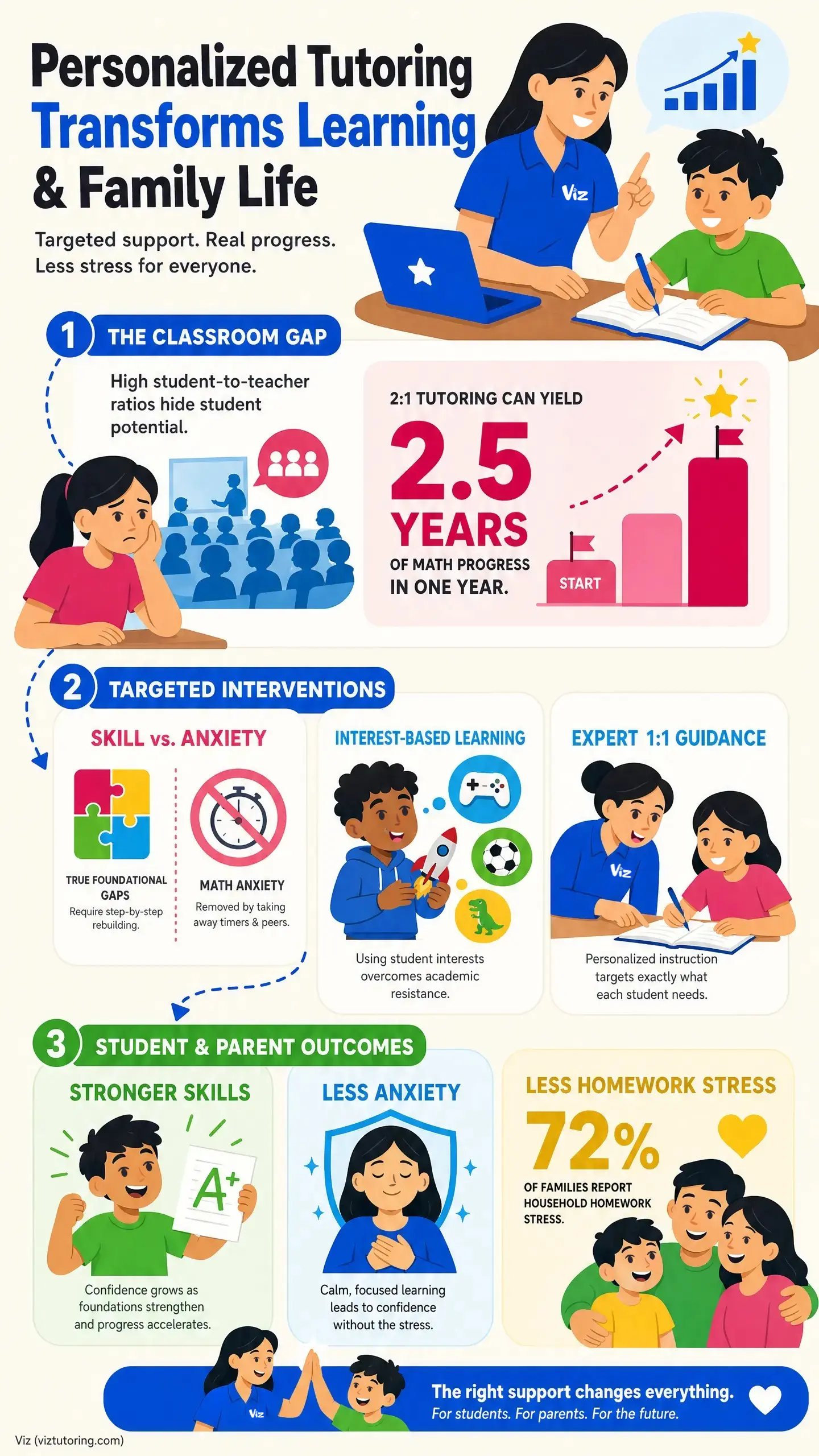
A while back I tutored a Grade 8 student who brought home one of the first math quizzes of the year with a 58%. Her parent’s reaction was instant. My daughter is falling behind, she needs someone to reteach the material.
I understood the panic. But she’d done every homework assignment leading up to that quiz, and on paper everything looked fine. What her parent couldn’t see was how she was doing it. She kept asking, “Is this right?” and “What do I do next?” If the textbook had an example at the top of the page, she followed it step for step. Hand her the first step and she could finish anything.
The quiz took all of that away. No example, no confirmation, nobody to give her the first move. She had no idea how to start.
A failing grade tells me the outcome, but not the cause. She understood the individual skills. What she hadn’t built was the ability to look at an unfamiliar problem and decide, on her own, which strategy to use. Reteaching the chapter would have changed nothing.
So for the first three weeks of school, don’t worry as much about grades, but track friction instead. Notice how long homework really takes against what the teacher intended. Twenty minutes of math stretching to an hour is information. Notice what your child asks for help with over and over, and what they do when stuck: push through, hunt for an example, or wait for you. Listen for whether they can explain their thinking without you leading them there. Write it down somewhere, because these patterns are really hard to see one evening at a time.
How Can Parents Differentiate Between Student Fatigue and an Academic Skill Gap?
September kids are wiped. They’ve gone from camp and sleeping in to six hours of sitting still, new activities, new friends, and, on top of all of that: homework. Please don’t diagnose anything from one rough Tuesday.
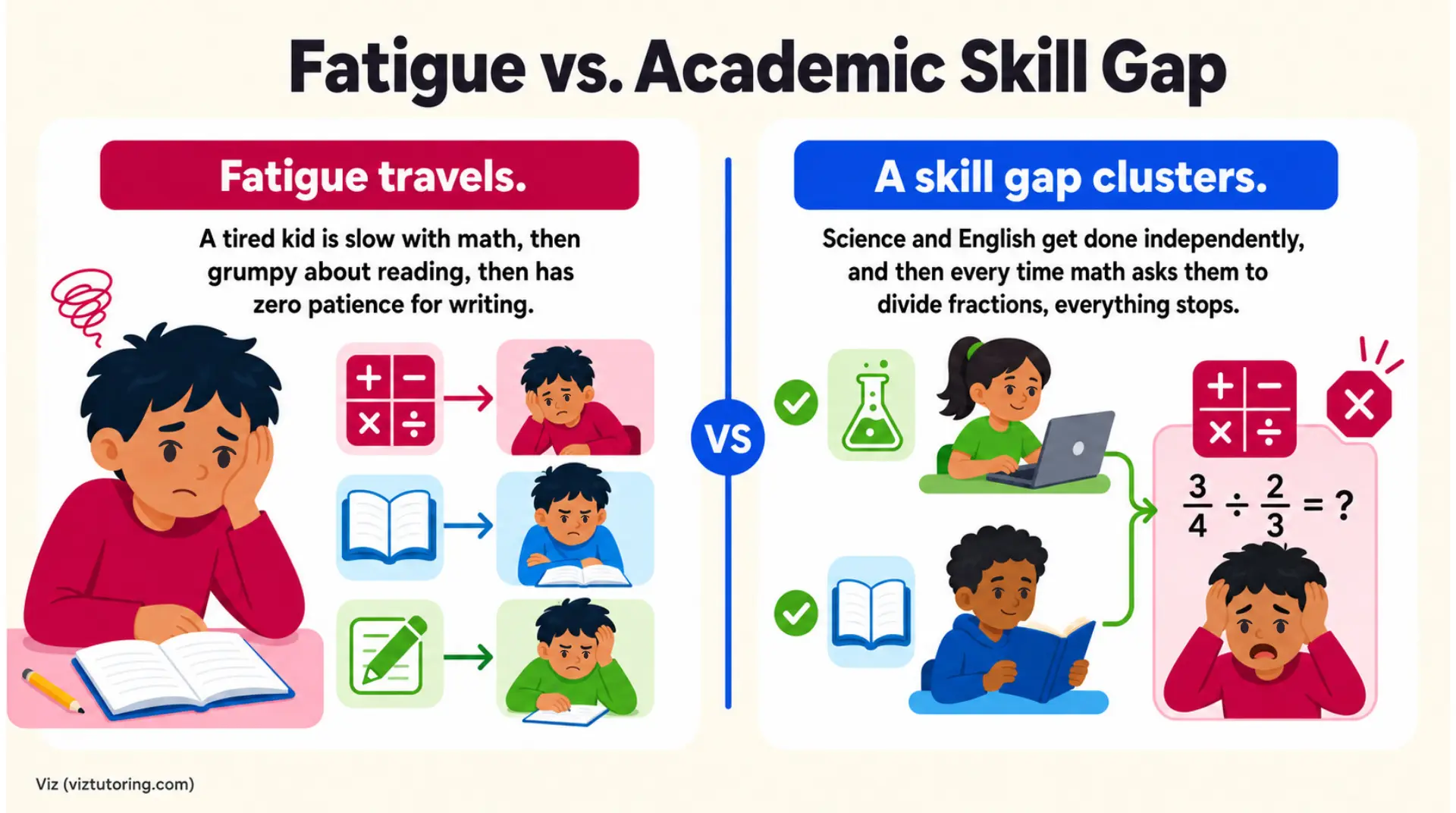
Once they’re rested, fatigue and a skill gap leave very different footprints. Fatigue travels. A tired kid is slow with math, then grumpy about reading, then has zero patience for writing. It moves across subjects and it shifts with circumstances. A snack, a break, a weekend of real sleep, and you often see a different child on Monday.
A skill gap clusters. Science and English get done independently, and then every time math asks them to divide fractions, everything stops. They dig through old notes. They grab a calculator for things they shouldn’t need one for. And the same bottleneck shows up on a night they slept 10 hours.
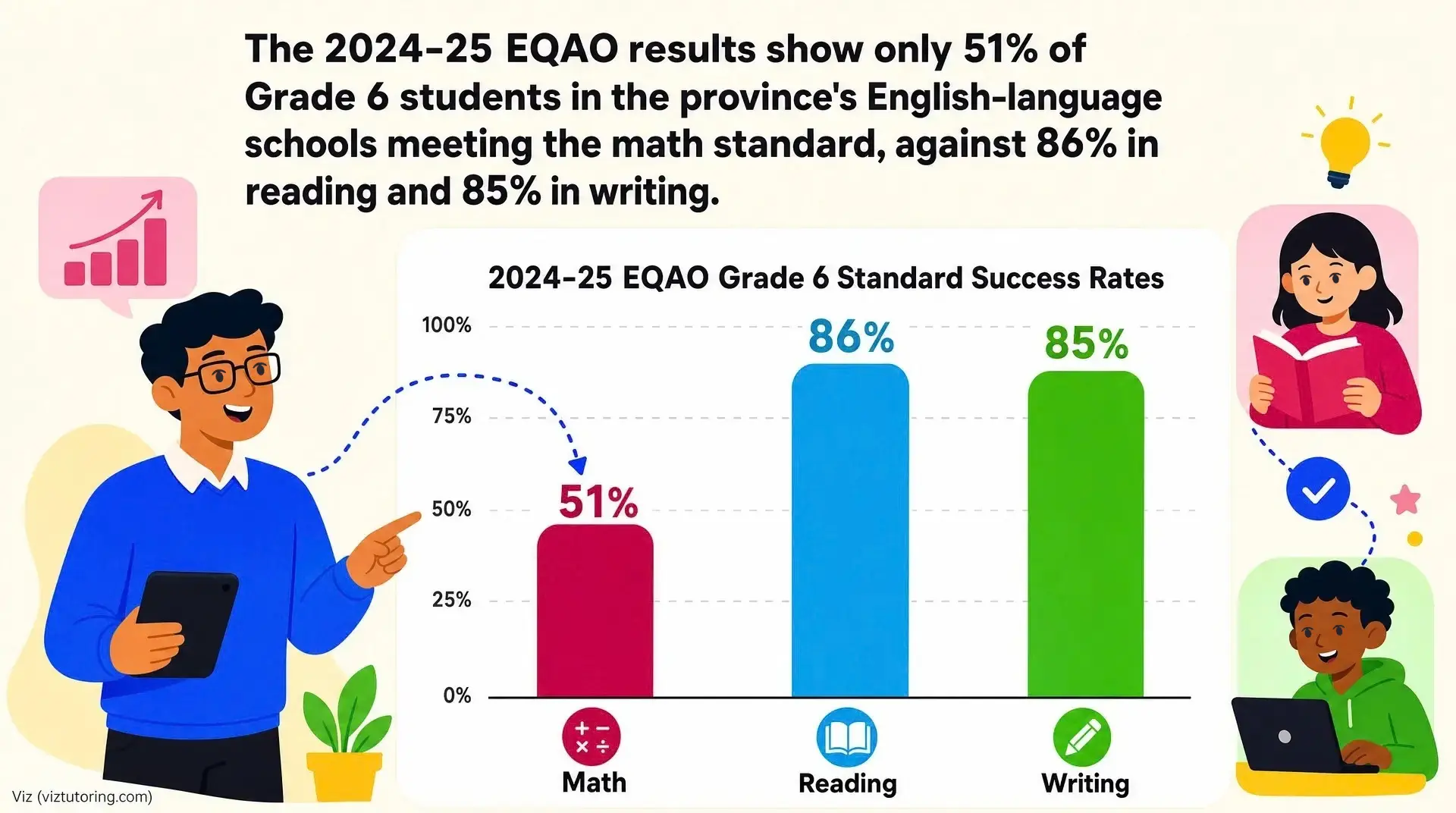
Ontario’s own data has that same shape. The 2024-25 EQAO results show only 51% of Grade 6 students in the province’s English-language schools meeting the math standard, against 86% in reading and 85% in writing. Fatigue would drag every subject down together. When math alone drops that far, something specific is going wrong.
So I look at three things. Does it improve when they’re rested? Does it happen everywhere, or around one subject, or even one type of task inside a subject? And does the same problem keep repeating? When it’s persistent, repeatable, and specific, I stop assuming the child needs more effort and go looking for the missing skill.
And it can be narrower than a subject. A parent might tell me their son is exhausted after school and math is taking forever. Then we look closer and find 30 minutes of that exhaustion landing on one spot, the moment a word problem has to become an equation. Straight computation is fine. He can even explain the problem out loud. He just can’t turn the words into a mathematical expression. That’s a specific skill somebody has to teach.
Why Must Parents Identify Underlying Foundational Skill Gaps to Fix Homework Struggles?

When the same kind of assignment blows up night after night, I stop asking how to get through it. The better question is, what does this assignment assume my child already knows?
Fractions are the classic case. When I was teaching Grade 5, fractions were usually where a problem became visible, even though they were rarely where it started. A child can shade in three-quarters of a circle all day. But finding a common denominator assumes they know their multiples. Simplifying assumes they can divide. So when a parent says “fractions,” I agree, and then we go look underneath.
This one follows kids for years. Researchers tracking students in the U.S. and U.K. found that a child’s grasp of fractions and division in elementary school predicted their algebra knowledge five to six years later, even after accounting for general intellectual ability and family background. Gaps in math don’t close on their own. They wait.
I worked with a Grade 5 student who had just moved to Toronto from New York. Homework had turned into full meltdowns with her parents. I noticed she was still counting on her fingers for facts that should have been automatic. So I set the Grade 5 material aside and rebuilt from manipulatives and smaller steps. It was slow and honestly tedious at times. Over time, she needed less and less from me and got noticeably more confident on her own.
Sometimes the fastest way forward is to go backwards for a few minutes. And it’s okay for a child to be behind the curriculum for a while. That’s the time it takes to catch up.
What Are the Two Phrases Parents Should Avoid Saying to Struggling Students in 2026?
Why Should Parents Avoid Telling Struggling Students to Try Harder?

To be honest, there were days as a teacher when I wanted to say it. But the kids I sit with are almost always trying. Something underneath is making the work impossible in the time they’ve been given. Telling a struggling child to persist, or to have a growth mindset, when they’re missing a skill is still “try harder,” just dressed up. Kids know it, too. I hear students say they hate hearing it.
My own marks slid in high school, and I was doing the homework. I had trouble with tests and with memorizing formulas. Nobody would have fixed that by telling me to focus.
What I’d say instead is, “Show me where you started to feel lost.” Kids can almost always point to the spot, and now you know where to look.
Why Is Asking “Do You Understand?” Ineffective for Gauging a Student’s Academic Comprehension?
Children will nearly always say yes. Sometimes they’re embarrassed. More often they honestly believe that watching you do the steps means they can do them.
In the same 2024-25 EQAO data, 64% of Ontario Grade 9 students said they understood most of the math they were taught. Only 58% actually met the standard. That difference is a lot of kids nodding.
I had an algebra student who nodded along perfectly while I worked through an example, then froze on the independent question. I stopped and asked, “Tell me what you think you should do first, and why.” That’s when it came out that they’d been copying my steps without knowing what the equation meant. We spent the rest of the session on that instead.
How Should Parents Match Tutoring Strategies to a Student’s Specific Learning Pattern?
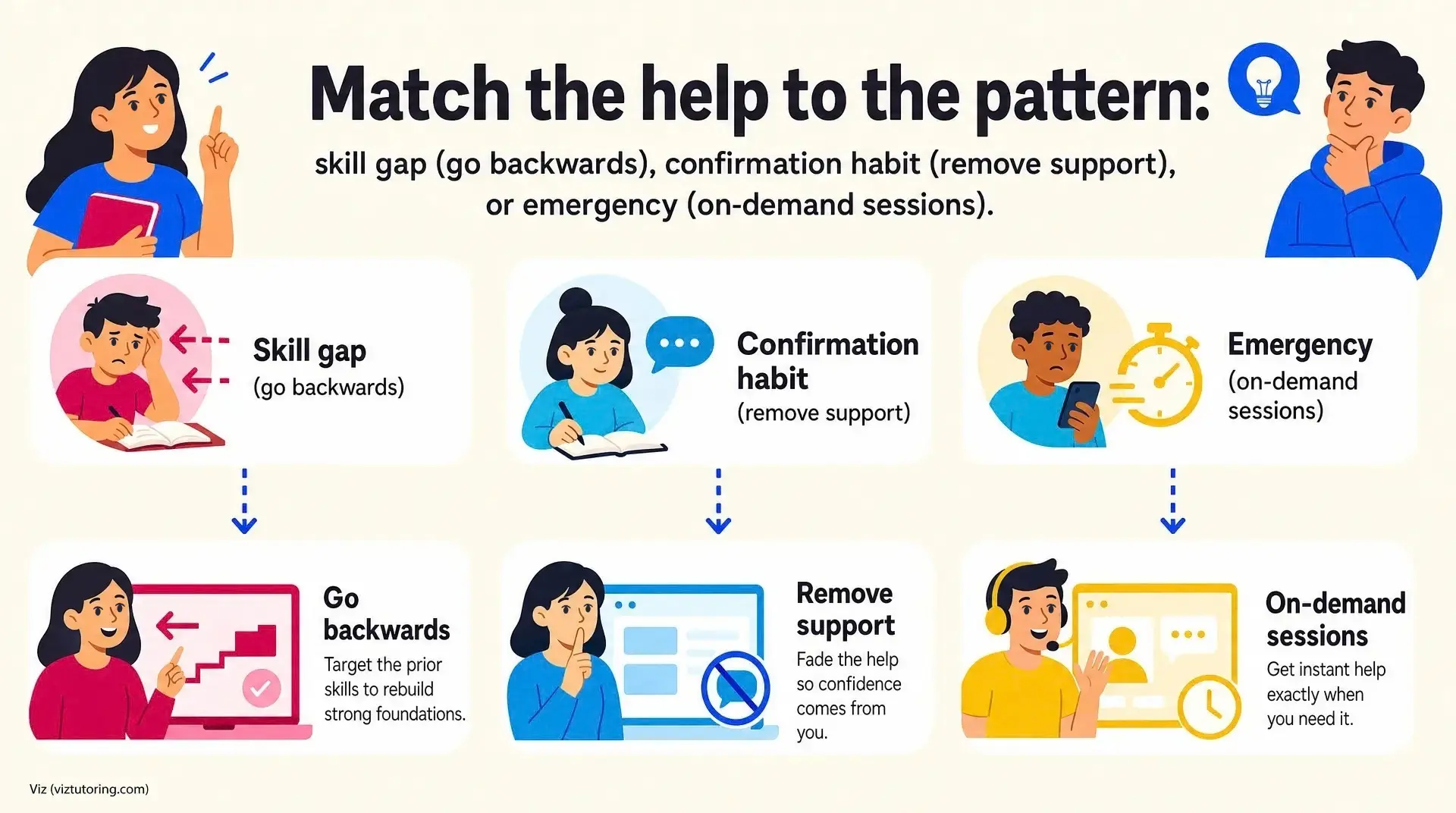
A real skill gap means ongoing work with the same tutor, and that tutor should be going backwards. My version is three steps. I do a question fully myself, we do one together, then the student does one alone. It’s slow. But the skill gap is what created the confidence problem, and low confidence is what stops a kid from practicing enough to close the gap. Easier material is the way back into that loop.
The confirmation habit, like my Grade 8 student, needs a tutor who removes support instead of adding it. Instead of showing the first step, they should be asking, “What do you notice? What have you tried? Which part looks familiar?” Then they should go quiet, sometimes for a long pause. It’s uncomfortable for everyone, and it’s where the learning actually happens. If the tutor is just helping your kid finish the next worksheet, the same thing happens on the next quiz. My own Grade 9 math teacher pointed at the right part of the question during tests, and I left his class with good marks and not much more math.
A true emergency, a missed class and a test tomorrow, is what on-demand sessions are for. Fifty-five minutes the night before can’t reteach a unit, but it can find the biggest gap, fix one or two misconceptions, and send your child off with practice questions. And it arrives right when frustration peaks, which is usually the moment a parent and kid are about to get into it.
When you correct your own child, you’re the person whose approval matters most to them, and the stress of being evaluated by you eats up the thinking capacity they need for the problem. At that point you’re looking at a threat response, and nobody does good math in that state. A meta-analysis pooling 223 studies found a clear negative link between math anxiety and achievement across nearly 400,000 participants. From a neutral third party, the exact same correction is just information.
Why Are Shared Interests and Personality Important When Selecting a Tutor?

Parents often underweight shared interests when looking for a tutor. I tutored a Grade 4 boy who insisted he wasn’t a writer. He loved hockey, so his assignment became “a day in the life of a hockey puck.” He wrote about the puck’s feelings during a slap shot and the roar of the crowd, and he made me laugh out loud. Interests are how a tutor earns trust fast, and they’re how “solve for x” turns into something a kid can picture.
When I hire, my one non-negotiable is whether the person is personable. Candidates run a mock session as part of the interview, and I’ve turned down flawless resumes because the person couldn’t get an idea across to me. If it isn’t clicking after a couple of sessions, switch. At Viz, rematching is free, and you won’t be paired with a declined tutor again.
What Questions Should Parents Ask a Tutor After the First Tutoring Session?
Instead of asking whether they finished the homework, ask the tutor where they saw your child get stuck, and what surprised them.
A good tutor will have noticed things. A long pause before starting. A correct answer erased and rewritten out of self-doubt. “I get it” said a little too quickly. An app hands your child the answer in two seconds and notices none of that. Those signals tell you whether you’re dealing with a gap, a confidence problem, or the two feeding each other.
Every Viz session ends with written feedback, and the recording stays available for 90 days so your child can rewatch an explanation they’ve forgotten. Wherever you get help, I think that’s the standard to expect.
The first signs it’s working won’t be on a report card. Homework time shrinks. “Is this right?” gets quieter. Your child starts explaining their thinking without being led there.
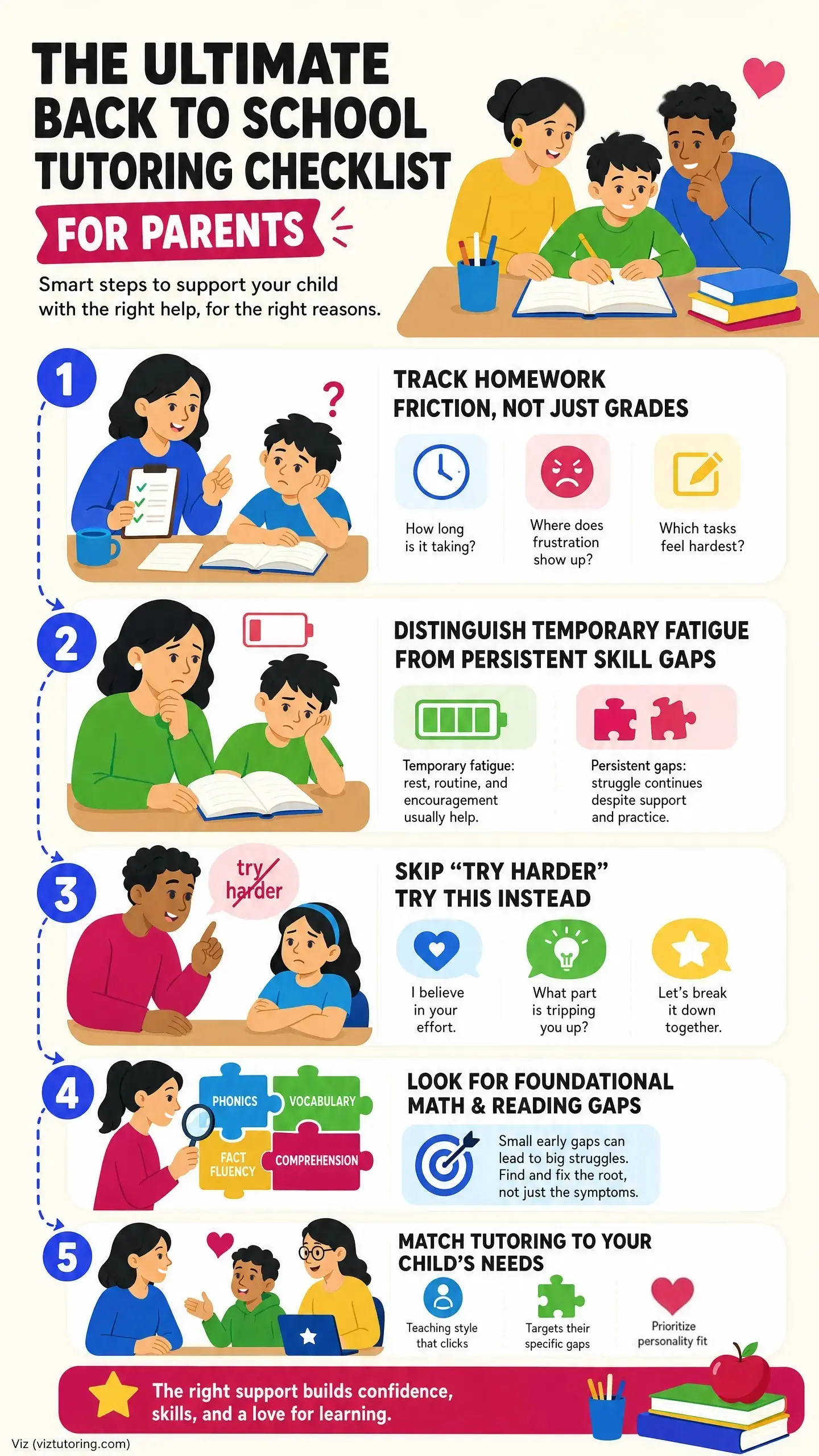
What Is the Condensed Back to School Tutoring Checklist for Parents?

- Weeks one to three: track friction, not grades.
- Run the three questions: better when rested? one spot or everywhere? repeating?
- Ask what the frustrating assignment assumes your child already knows.
- Stop saying “try harder” and “do you understand?”
- Match the help to the pattern: skill gap, confirmation habit, or emergency.
- After session one, ask where they got stuck rather than whether they finished.
A rough September on its own tells you very little. Where the friction sits, and whether it moves when your kid is rested, tells you almost everything.
Frequently Asked Questions
Will my child become overly dependent on their back to school tutor?
Not if the tutor uses the right approach. The instinct is to hold a struggling child’s hand, which manufactures failure. A good tutor actually removes support over time. We go backwards to rebuild foundational skills, then use deliberate silence to force independent thinking. That discomfort is where genuine learning happens.
Is it too late to start back to school tutoring for high schoolers?
Absolutely not. While gaps hide for years, adolescents still see massive academic gains. A rigorous study on high-school tutoring showed math test-score jumps of 0.37 standard deviations. You just need a relatable tutor.
How should I respond if my child resists back to school tutoring?
Shift the narrative. When parents correct homework, it often triggers a threat response. Research shows a strong negative link between math anxiety and achievement. Explain that a tutor isn’t a punishment. They are a neutral third party stepping in to permanently end the evening arguments and relieve the pressure.
How quickly will back to school tutoring improve my child’s grades?
It takes time because gaps don’t close on their own. They wait. The first signs of progress aren’t higher grades – they are a reduction in homework time and fewer ‘Is this right?’ questions. Expect the first few weeks to focus entirely on tedious, foundational rebuilding before you see test scores shift.
Should we sacrifice sleep or extracurriculars to fit in back to school tutoring?
No. Tutoring should support a student’s routine, not compete with sleep, sports, or other activities. A focused 55-minute session can help students work through gaps more efficiently, making schoolwork feel more manageable for the rest of the week.