

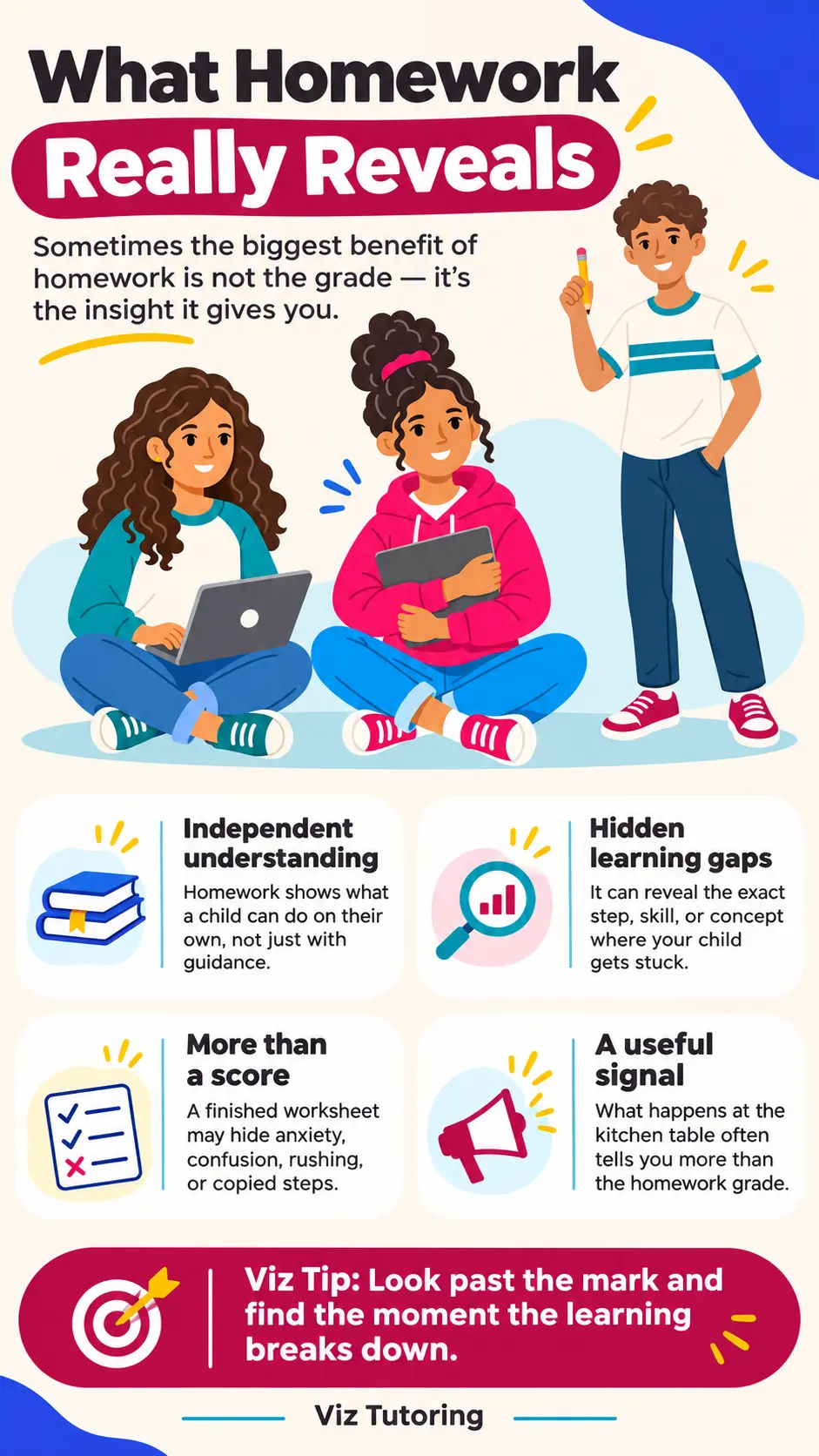
Homework can help children practice what they’ve learned in class, develop independent learning skills and uncover gaps in their understanding. But from what I’ve seen as a classroom teacher, its most overlooked benefit is showing the difference between understanding something with guidance and being able to apply it on your own.
As a classroom teacher, I saw this so many times. I’d teach a math lesson, then have students work through questions while I walked around and checked in, or while they worked with a partner. They’d follow my explanations and answer correctly. Then they’d go home, try similar questions by themselves, and get stuck. For a parent, that moment at the kitchen table is some of the most useful information you’ll get about how your child learns.
Key Takeaways
- Homework can reveal the difference between what children understand with classroom guidance and what they can do independently.
- A 2024 research review found that homework improved arithmetic computation and problem-solving, but found no significant improvement in arithmetic conceptual understanding.
- In PISA 2025, 15-year-olds who reported spending more time on homework tended to have higher science scores up to about two hours a day. Beyond that, scores tended to be lower.
- A 2026 meta-analysis involving 35,702 students found that homework quality and meaningful feedback were more strongly associated with learning than feedback quantity.
- US and UK longitudinal data show that an elementary student’s understanding of fractions and division predicts their algebra proficiency and overall math achievement five to six years later.
- Repeated homework difficulties in the same subject can point to foundational learning gaps, particularly when they persist even after rest.
- Parents can support independent learning by guiding children through their thinking rather than supplying answers.
What Can Homework Tell You That Grades Can’t?

Whether it comes from a study or a report card, a score tells you the outcome, but not the cause. It won’t show you whether your child is missing a skill from an earlier grade, misreading the question, rushing, or freezing up because they’re anxious.
Research on the benefits of homework from 2024 to 2026 links homework time, quality, feedback and parent support to achievement, but it measures outcomes, not why one child struggles.
|
Homework study (year) |
What it measured |
Finding on learning or achievement |
What it can’t show |
|---|---|---|---|
|
OECD PISA 2025, more than 760,000 students aged 15 in 91 countries and economies |
Homework time per day |
Science scores higher with more homework up to about 2 hours a day, lower past that |
Whether more homework causes lower scores, since struggling students may need more time |
|
Xu et al. (2026), meta-analysis of 29 studies involving 35,702 students |
How homework quality, teacher feedback and support relate to student learning outcomes |
Homework quality, feedback quality and support for student independence were more strongly associated with learning outcomes than the amount of feedback. |
Cause and effect, since results are correlational and few studies covered high school |
|
Guo et al. (2024), review of 14 K–12 comparisons |
How students who did homework compared with students who didn’t on two skills: doing calculations and understanding the math behind them |
Students who did homework scored higher on calculation tasks. |
Whether homework generally helps students understand math concepts. Only 3 of the 14 comparisons measured that skill. |
|
Xu et al. (2024), Psicothema. Review of 28 studies with 378,222 participants, from elementary through high school. |
How different ways parents help with homework relate to how well students do in school. |
The only type of parent involvement linked to higher achievement was giving students guidance while letting them work through problems themselves. |
Whether the way parents helped caused students to do better or worse in school. |
A grade can also look better than the understanding behind it. The teacher I swore I’d never become was my Grade 9 math teacher. Everybody did really well in his class, because during tests he’d walk around, point to specific places in a question when someone was struggling, and ask “Are you sure?” when someone was on the wrong track. I left with a good grade and a handful of tricks, without really understanding what I’d learned.
Homework can hide the same thing. Some kids rush and get so focused on finishing that they apply the same strategy over and over without questioning it. Sometimes they’ve learned a procedure without understanding why it works or when to use it, so a finished worksheet can look more reassuring than it should. A 2024 review of homework experiments found homework linked to gains in arithmetic computation, but not to a measurable gain in arithmetic concepts, though only three of its comparisons measured concepts. When I see a child rushing like that, I take the focus off finishing and have them walk me through one problem, step by step, so I can see exactly where their understanding breaks down.
Why Can My Child Do the Work at School but Not at Home?

In a classroom, a child gets a lot of small help without asking for it. The teacher walks past their desk, and the friend beside them is working on the same question. With 25 or 30 kids in an hour-long class, even a teacher doing nothing but one-on-one help would get about two minutes per child, so a kid who’s quietly lost is easy to miss.
At home, that help is gone, and the gap shows. What stood out to me was that my students often understood the math and still couldn’t figure out where to start without someone guiding each step and checking in. So instead of immediately explaining how to solve a problem, I started asking students to talk me through their thinking and tell me what they already knew. Then I gradually pulled back my guidance.
One algebra student I worked with nodded along perfectly while I explained a new concept, then froze when they tried a problem alone. I asked, “Tell me what you think you should do first, and why.” Their answer showed they’d been mimicking my steps, so I changed course and taught what the equation actually meant.
“Do you understand?” is often a terrible assessment question. Kids will almost always say yes, either because they’re embarrassed or because watching someone else do the steps has convinced them they’ve got it. Our tutors at Viz Tutoring ask things like “What do you notice?”, “What have you tried?” and “Which part looks familiar?” instead, and you can ask those at the kitchen table, too.
A Grade 8 student I tutored scored poorly on an early math quiz. The quiz showed me that she knew the material and needed practice getting started without checking with me first. That habit and leaning heavily on the textbook examples can both sit behind a bad grade, and you can spot either one at home.
Why Does More Homework Reinforce Student Mistakes Without Quality Teacher Feedback?
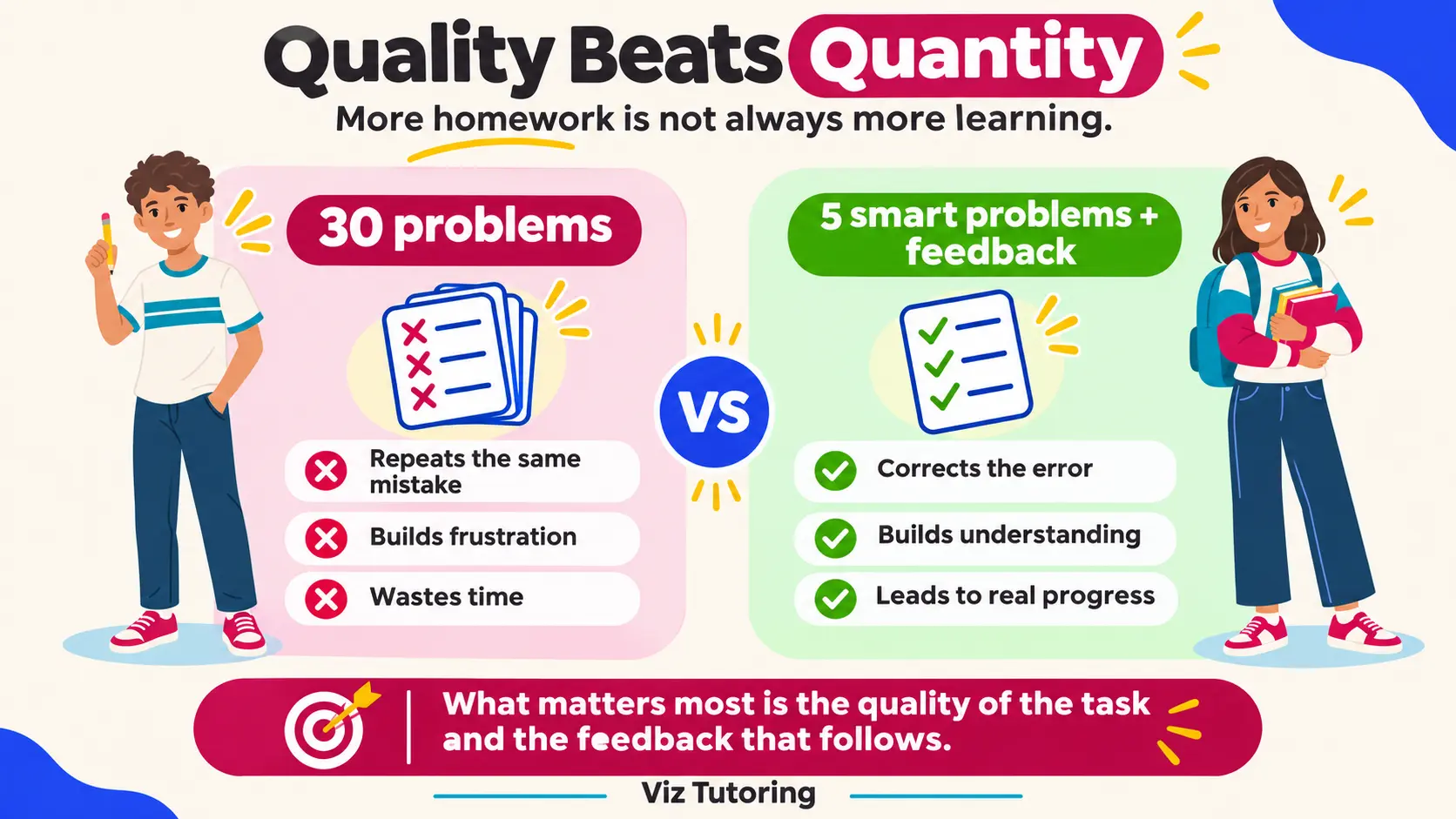
The belief that more homework means more learning falls apart once you look at what a child is actually doing with that time. A student might spend an hour on 30 math problems. If they’ve misunderstood the underlying concept, they could be repeating the same mistake over and over again and reinforcing the wrong approach. A student who does five carefully chosen problems and gets meaningful feedback finds out where they went wrong, and can learn much more in much less time. A 2026 meta-analysis of 29 studies and more than 35,000 students points the same way: the quality of the homework and of teachers’ feedback was more consistently linked to learning than the amount of feedback.
Time can mislead you, too. When a 15-minute assignment takes your child an hour, those extra 45 minutes are telling you they need support somewhere. In the PISA 2025 results, 15-year-olds who reported spending more time on homework across all subjects tended to have higher science scores up to about two hours a day. Beyond that, scores tended to be lower. The OECD cautions that this doesn’t show the extra homework caused the lower scores, since students who are struggling may need more time. That’s exactly how I’d read that hour at your kitchen table. I think we should be measuring the value of homework by what a child learns from it rather than by how long it takes.
Is My Child Struggling with Homework Because of Learning Gaps, Fatigue or Anxiety?
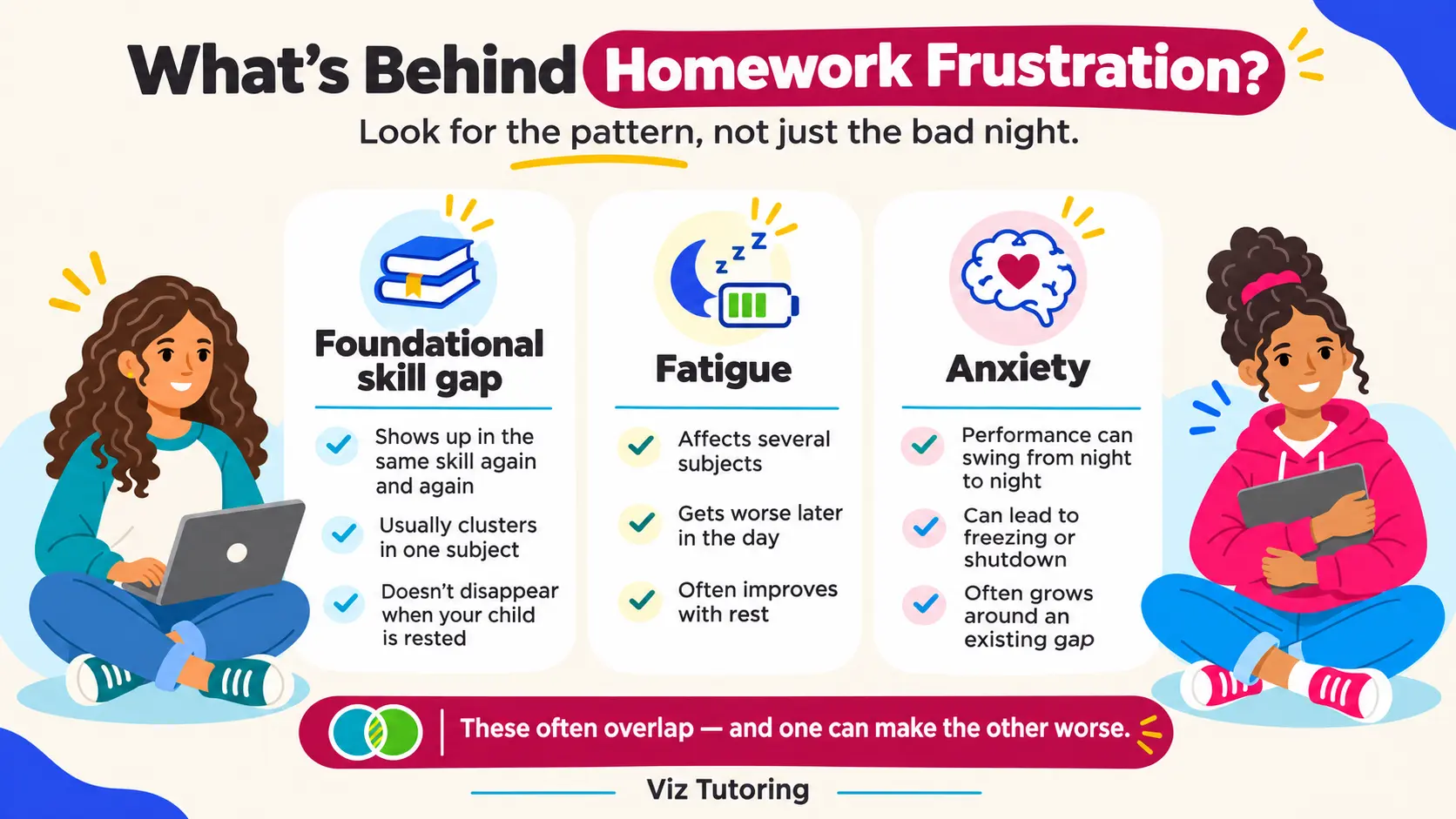
The homework fights that point to a deeper learning gap tend to center on the same subject again and again, stretch a 20-minute assignment into an hour, or end with your child suddenly shutting down or announcing, “I’m bad at math.” Fatigue looks different, because it generally affects several subjects and gets better with rest. Anxiety can make performance swing from one night to the next. A skill gap clusters around something specific, like turning a word problem into an equation, and keeps showing up even when your child is rested.
A lot of the time, anxiety and a skill gap come together. Children can develop anxiety after months of working around a gap, and by the time an adult notices, each is feeding the other. If you’re not sure which you’re seeing, try revisiting a similar question when your child is rested. Ask them to explain what the question is asking and how they’d get started. If they repeatedly get stuck at the same step, bring that specific example to their teacher or tutor. It’s much more useful than simply saying they’re struggling with math.
In the first few weeks of school, I’d track friction more than grades: where your child slows down, what they keep asking you for help with, and what they can’t finish on their own. And when the same assignment keeps causing frustration, the question to ask is what that assignment assumes your child already knows.
When I taught Grade 5, problems often first became visible in fractions, even when they’d started somewhere else. A child who’s shaky on division can struggle to simplify a fraction, and one who doesn’t know their multiples can struggle to find a common denominator. Long-term data from the US and the UK shows how long that foundation keeps mattering. What elementary students knew about fractions and division predicted their algebra knowledge and overall math achievement five to six years later, even after accounting for factors like general ability and family income. So if you’ve noticed your child struggling with fractions, you’re right, and it’s still worth asking what’s underneath.
I worked with a Grade 5 student who often got overwhelmed while doing homework with her parents. I noticed she was still relying on finger counting, so I set the Grade 5 material aside and used manipulatives and smaller steps to rebuild her basic math skills. She became more independent and more confident, and needed less and less support. Finger counting is worth noticing at home, and so are lots of margin notes for calculations that should be automatic.
Sometimes the gap is translation. Kids who freeze on word problems often have the computation skills but get stuck turning a paragraph into an equation. One student froze on a problem about a one-time setup fee and a monthly cost, so I put the worksheet aside and asked her three questions: what are you paying once, what are you paying over and over, and what part can change? Once she’d answered those, she could write the equation.
What Helps When Homework Turns Into a Battle?

The advice that frustrates me most is “You just need to try harder” or “You just need to focus,” even though I sometimes felt like saying it myself as a teacher. A lot of the time, the kids I see are already trying really, really hard. Something underneath may be keeping them from understanding the questions or finishing in time. I’d swap those phrases for “Let’s figure out what’s making this so hard” or “Show me where you started to feel lost.”
Growth mindset gets used the same way. I love the idea behind it, but the term is so overused that I hear kids say they hate it. “Come on, have a growth mindset” can sound like blame to a child who’s already working hard and just missing a foundational skill. Sometimes the most growth-minded thing a child can do is stop using a strategy that isn’t working, ask for help and try something different, instead of repeating the same approach while getting more upset.
When homework turns into a battle, a child can go into a threat response. The stress of being evaluated by a parent whose approval matters so much to them takes up the mental room they need for the problem itself. Sometimes a child who pushes your help away is trying to escape the feeling that comes with being helped. A tutor can step in as a neutral third party, and a correction from someone outside the family is easier to take as information about the work.
When your child is melting down, I’d stop asking how to get them to finish the question and start asking how to make it smaller. You can cover up part of a long problem, swap in smaller numbers, or draw it out. Sometimes the most productive way forward is to go backwards for a few minutes, to a version your child can do, and build forward from there.
How Can Parents Help with Homework Without Doing Too Much?
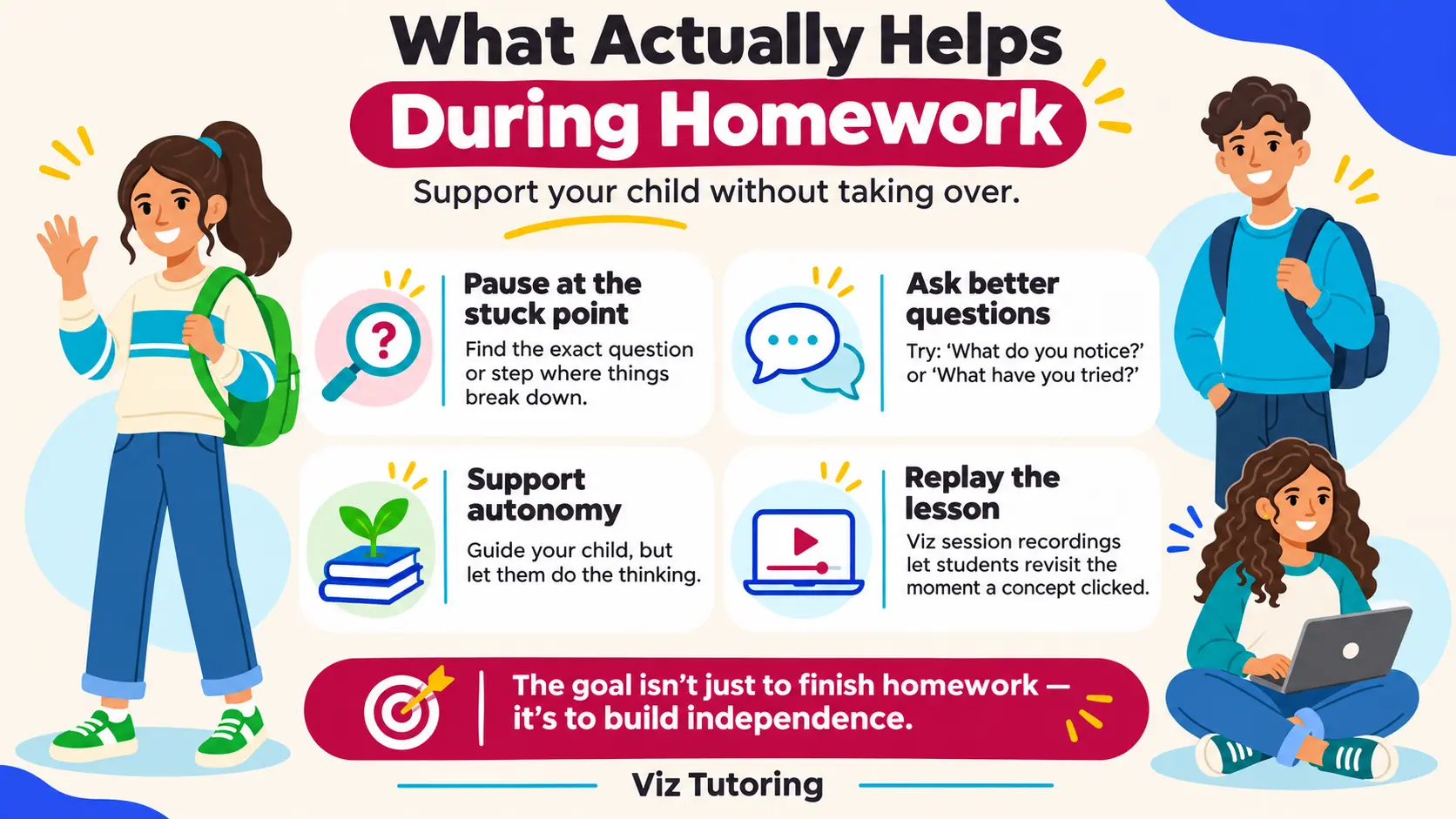
When a child works through homework alone, even the struggling part builds skills that reach well past the assignment. They have to think critically, try different approaches and figure out why something isn’t working. They have to be honest enough to tell their teacher the next day that they got a question wrong or didn’t fully understand it. Over time, that builds self-awareness as a learner: noticing when you don’t understand, working out why and asking for help.
I want kids to learn that they can get better at difficult things, and also that they don’t have to figure everything out by themselves. Helping too much undercuts the first half of that. When an adult takes over, the problem gets solved, but the child can come away believing they can’t do it alone. Researchers who pooled 28 studies found that, overall, more parental involvement in homework was linked to lower student achievement. Autonomy support, meaning backing your child’s own work instead of taking control or supplying answers, had a positive link.
I’ll sit through a long pause before prompting a stuck student because that quiet time gives them room to work and lets me see how they think. An AI chatbot can explain a problem, but when it gives an immediate answer, it can skip that valuable thinking time. A tutor can also notice when a child hesitates, says “I get it” too quickly or erases a correct answer out of self-doubt.
A lot of homework frustration comes from one particular feeling: a child knows they understood something yesterday, and today they can’t recreate the steps. I kept seeing students explain a concept back to me confidently in a live session, then tell me later it had vanished during a quiz or test. So we built session recordings into Viz Tutoring. When homework stalls, a student can rewatch the moment in their own session where the idea first clicked, and often a few minutes is all they need to get going again.
So when homework at your house runs long, or ends with your child saying they’re bad at math, look past the clock and the grade for the point where it broke down: which question, which step, and whether they could have started without you. If you’re noticing these patterns at home, our tutors at Viz Tutoring can help identify where your child’s understanding breaks down and work with them to become more independent. You can book one-on-one online tutoring in advance or on demand when your child gets stuck, without committing to ongoing sessions.
Frequently Asked Questions
Does homework actually teach my child better time management?
Yes, but the format matters. A study of 1,170 students found structured digital homework improved time management, while paper assignments helped kids organize their study environments. The true benefit isn’t just practicing math. It’s building distinct self-regulation skills your child needs for long-term academic independence.
At what age do the academic benefits of homework become noticeable?
Homework benefits shift as children grow. Research syntheses show stronger achievement correlations in grades 7 – 12 than in K – 6. For elementary students, the true benefit isn’t a massive grade boost. It’s establishing routines, spotting foundational gaps early, and learning to manage frustration before high school intensity hits.
Does all math homework provide the same academic benefit?
No. Repetitive math homework can improve calculation skills without necessarily deepening understanding. Effective math practice also helps children understand why a method works and when to use it. A tutor can identify gaps in that understanding and help students apply what they’ve learned to unfamiliar problems.
How do working memory and anxiety impact my child’s ability to benefit from homework?
Anxiety can make it harder for children to hold information in their working memory, which they need to solve multi-step problems. A child may understand each step individually but struggle to put them together. A tutor can help by breaking problems into smaller steps and gradually building independence.
How do I know if my child needs a tutor or just more homework practice?
If your child keeps making the same mistakes, relies on someone to guide them through each step or struggles with similar questions even after practicing, more homework alone may not help. A tutor can work backwards to identify what’s missing and help your child develop the skills they need to work independently.
How much homework is too much for my child?
There isn’t one ideal amount of homework for every child. Age, assignment difficulty and existing academic skills all matter. If homework regularly takes much longer than expected, interferes with sleep or ends in frustration, speak with your child’s teacher. They may need a different approach or additional academic support rather than more time spent practising.