

The most damaging presence at the homework table is usually the parent trying hardest to help.
A meta-analysis of 28 studies found that parental involvement in homework is negatively associated with achievement. Children of math-anxious parents learned less math over the year, but only when those parents helped frequently.
Your own childhood math stress crosses the kitchen table without a single word, and the instinct that feels most responsible is quietly teaching your child to freeze.
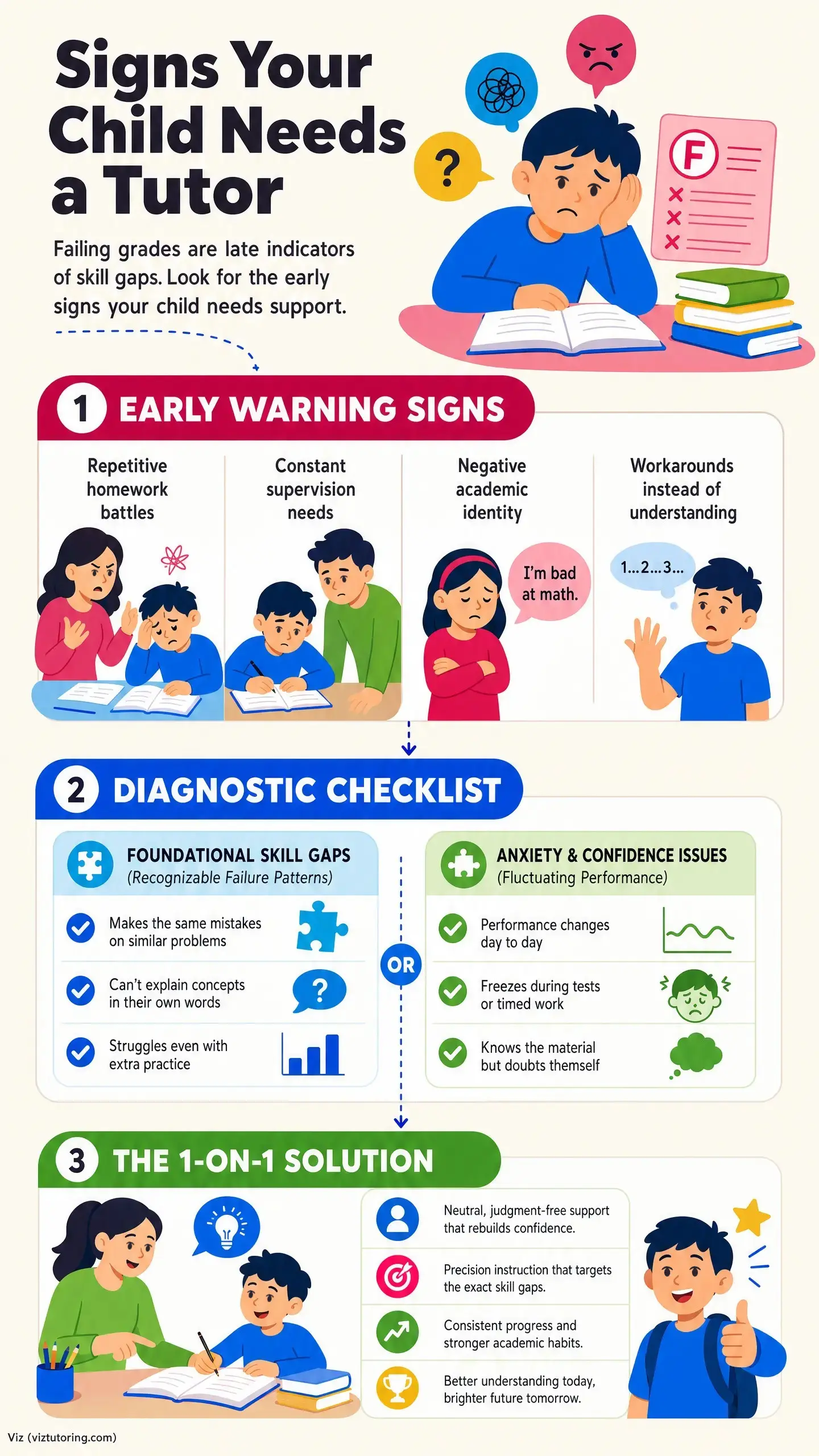
Key Takeaways
- A meta-analysis of 28 studies indicates that parental involvement in homework negatively impacts student achievement, especially when math-anxious parents provide frequent assistance.
- A child’s grasp of fractions and division in elementary school predicts their high school math achievement five to six years later, independent of IQ and family income.
- Toronto school board statistics reveal that an average Grade 4–8 class has 24.8 students, meaning that even if a teacher dedicated an entire 60-minute lesson to individual attention, each child would receive less than two and a half minutes.
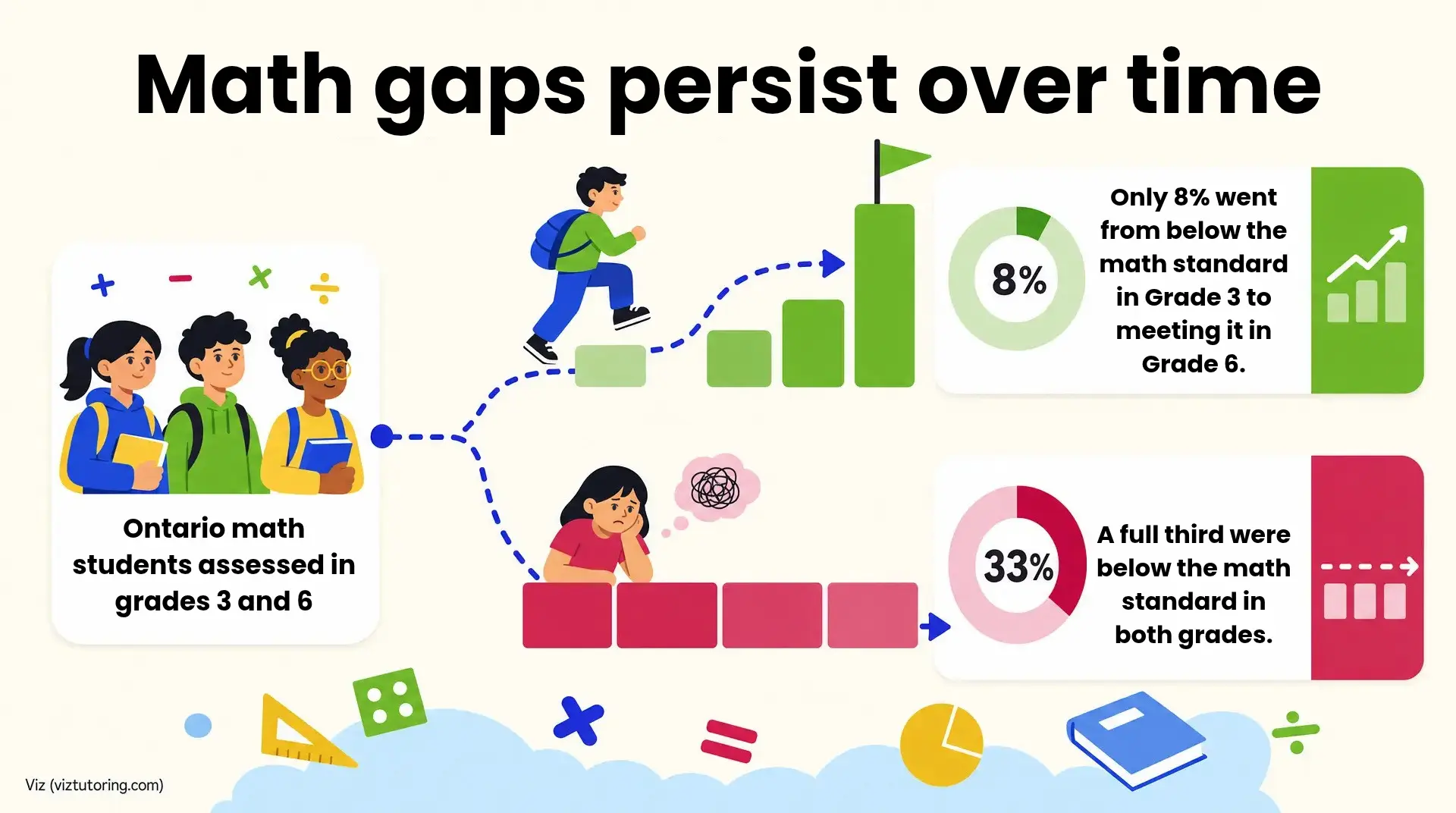
- Ontario EQAO tracking data reveals that only 18% of students performing below the provincial math standard in Grade 3 reached the standard by Grade 6.
- The U.S. National Mathematics Advisory Panel notes that strategies like finger counting can consume limited working memory resources, making it harder for students to tackle more complex math problems.
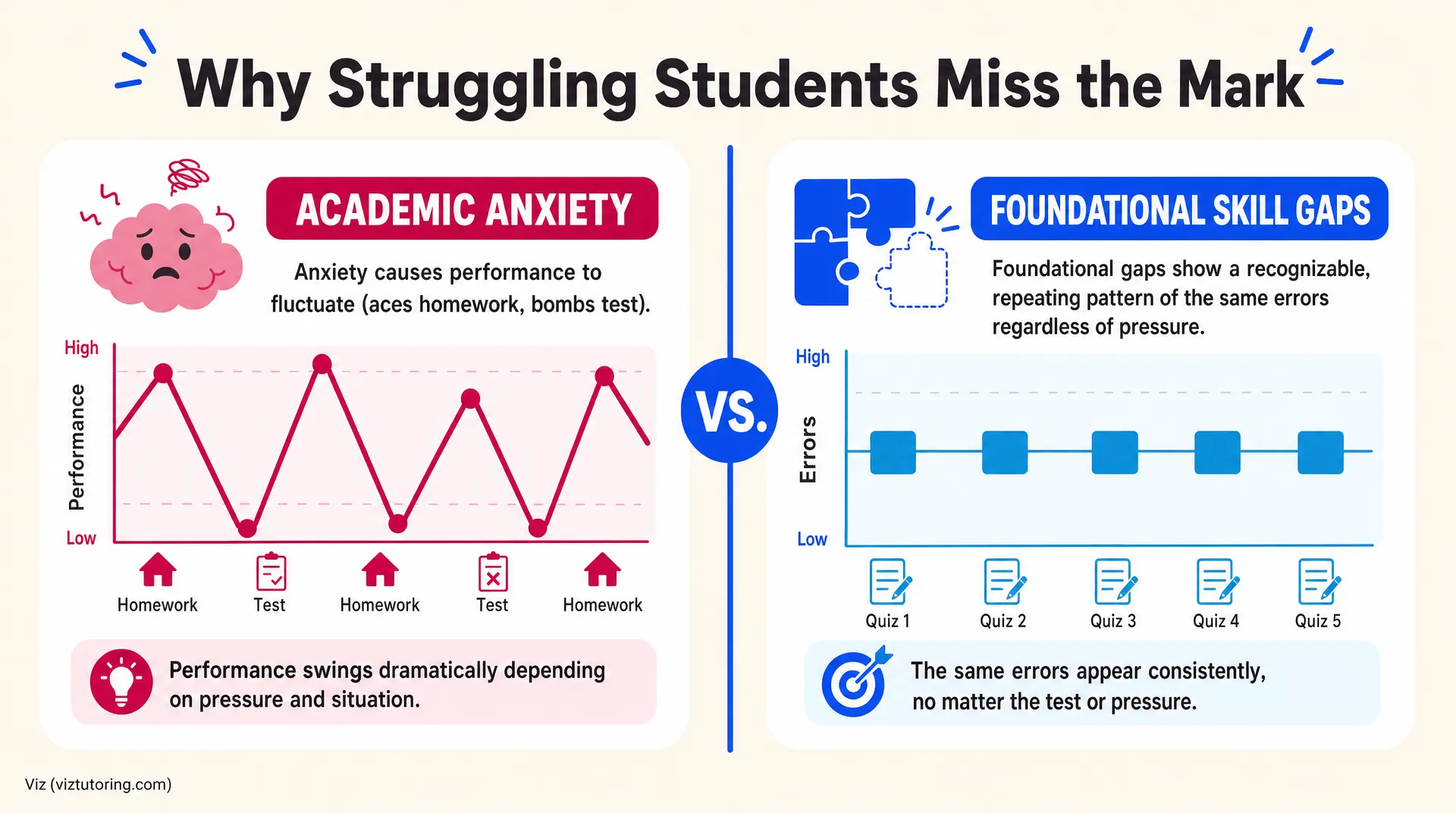
- Math anxiety can cause student performance to fluctuate between homework and tests, whereas missing foundational skills may lead to recurring calculation errors, even without time limits or pressure.
- The Education Endowment Foundation estimates that structured one-to-one tutoring interventions deliver an average of five additional months of academic progress for struggling students.
Why Are Failing Report Card Grades Late Indicators of Student Skill Gaps?
A failing grade might tell me the outcome, but not the cause. By the time a mark drops, the gap underneath it has usually been growing quietly for a long time.
Fractions is my favorite example, because I watched it play out every single year in my own classroom. Fractions was a lot of the time the point where the problem really became visible, even though it might not be the original problem. Simplifying a fraction is division. Finding a common denominator is multiplication. If those skills never got solid in Grade 3 or 4, fractions is simply where everything collapses in public.
And the stakes are higher than most parents realize. One long-term study found that a child’s grasp of fractions and division in elementary school predicted their high school math achievement five to six years later, even after accounting for IQ and family income.
You might assume the school will catch the gap early. I wish that were true. Toronto District School Board’s most recent statistics put the average Grade 4 to 8 class at 24.8 students. Divide one hour of math by 25 kids and each child gets about two and a half minutes of individual attention. That’s before the lesson itself, before transitions, before someone needs a bathroom break. I say this with zero criticism of teachers, because I was one. The limitation is the classroom model itself.
The provincial numbers show what that limitation costs. When EQAO tracked more than 114,000 students from Grade 3 to Grade 6, only 18% of those below the math standard in Grade 3 ever climbed up to it. A full third never met it at all. Math gaps do not quietly fix themselves. From what I’ve seen, they compound.
Why Are Repetitive Homework Conflicts the First Sign a Child Needs Tutoring?

Every family has homework battles. Kids get tired, parents come home stressed, and one awful Tuesday means nothing.
I become concerned when the same conflict keeps happening again and again around the same subject, especially when your child can’t clearly explain what they’re stuck on. “I just don’t get it,” night after night, about the same type of problem, is worth taking seriously. So is homework designed to take 20 minutes that routinely stretches past an hour. So is a child who can’t work at all unless you’re sitting beside them for every single step.
That last one deserves a closer look, because most parents treat constant supervision as the responsible fix. To be honest, the research here is uncomfortable. A meta-analysis of 28 studies found that parental involvement in homework is actually negatively associated with achievement, while support that builds independence is positively associated with achievement. Even more striking: a large study of first and second graders found that children of math-anxious parents learned less math over the year, but only when those parents helped frequently with homework. Your own old math stress can transfer across the kitchen table without a single word.
Why Do Negative Academic Identities Indicate a Need for Educational Tutoring?
This is the sign I take most seriously because it means the struggle has hardened into an identity.
Listen for the sudden declarations. “I’m bad at math.” “I hate writing.” “I can’t do this.” Then, watch what travels with them: shutting down mid-assignment, hiding tests from you, quitting before even attempting a question, new anxiety around one specific class.
The timing is predictable, and Ontario’s data maps it precisely. In EQAO’s student surveys, 67% of Grade 3 students say they like math and 64% say they’re good at it. By Grade 6, both numbers fall to roughly half. Somewhere in those three years, an enormous number of kids quietly decide math isn’t for them.
I’ve never met a child for whom that belief was actually true. I once tutored a Grade 4 boy who was certain he wasn’t a writer. Hated writing, avoided it completely. He also loved hockey. So instead of another worksheet, I gave him an assignment: a day in the life of a hockey puck. What he wrote genuinely made me laugh. The puck’s feelings during a slap shot. The roar of the crowd. The indignity of being stolen from one team by the other. The creativity was there the whole time, sitting underneath a belief nobody had thought to question.
How Do Academic Workarounds Like Finger Counting Indicate Missing Foundational Math Skills?
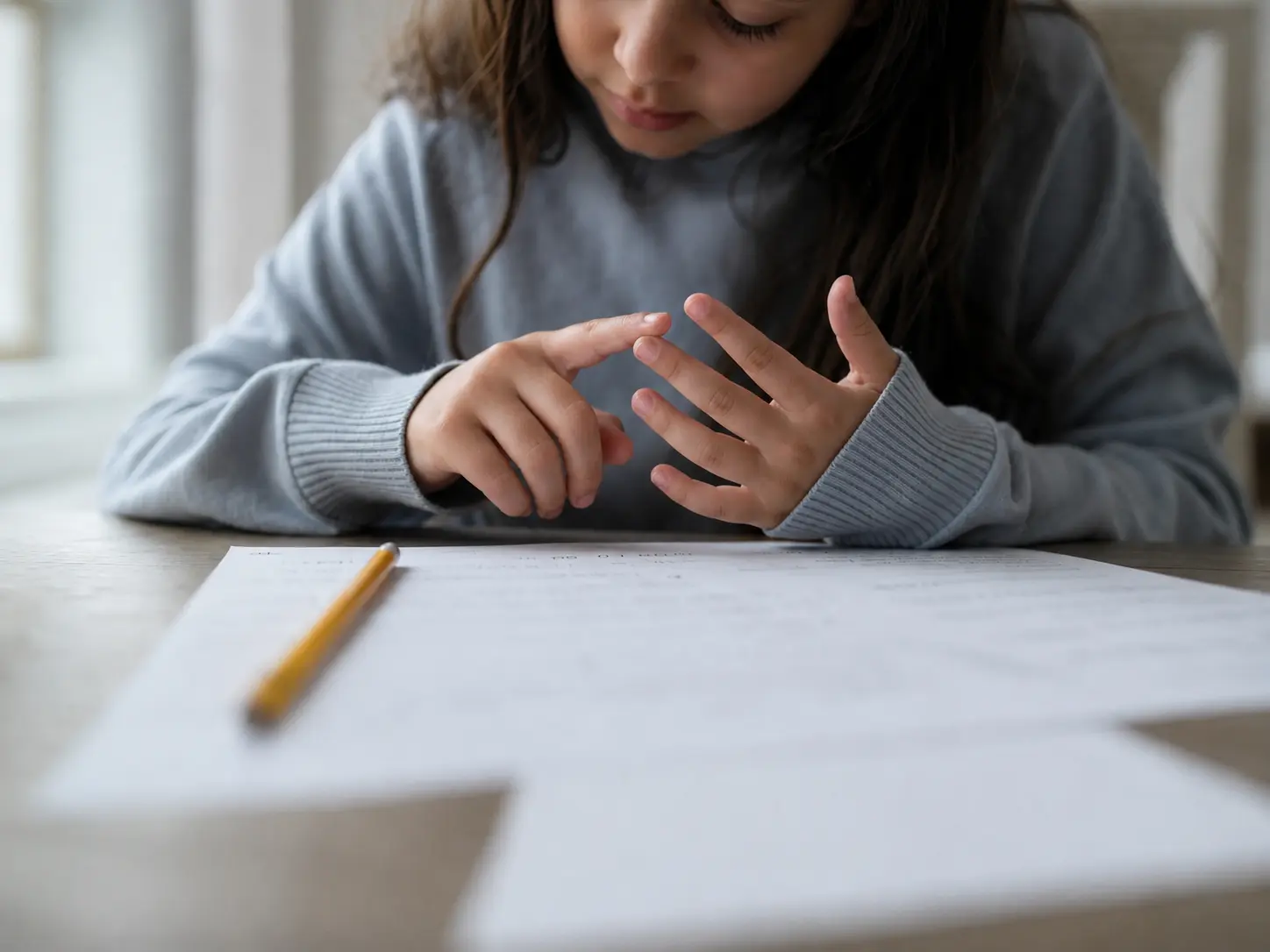
Parents miss this sign the most because catching it means watching how your child works instead of checking whether the answer is right.
When I sit down with a new student, I look for overcompensation. Is a Grade 5 student still counting on their fingers for basic multiplication? Are there tiny pencil notes crowding the margins for calculations that should be automatic by now? Can they explain a concept perfectly out loud, then freeze when the same question appears on a worksheet?
These workarounds matter because they’re expensive. The U.S. National Mathematics Advisory Panel found that automatic recall of basic facts frees mental resources for complex problem-solving, while counting out simple facts drains them. A child compensating for a missing skill is running two programs at once on limited memory. From the outside, that drain gets labeled laziness or attitude. From the inside, it’s pure exhaustion.
How to Differentiate Between Academic Anxiety and Foundational Skill Gaps in Students?
When parents hand me a pile of past exams, I look for one of two distinct patterns.
Anxiety can make performance fluctuate quite a bit. Your child aces the homework, then bombs the test. A concept they explained perfectly on Sunday evaporates by Monday morning. In my experience, a student who presents a lack of confidence often knows much more than they initially show. The knowledge is there. Pressure keeps scrambling access to it.
Foundational gaps behave differently. They show up repeatedly, in a recognizable pattern: the same type of question going wrong the same way, whether the child is relaxed or stressed, timed or untimed.
My way of telling them apart is to change one thing at a time. I take away the timer. I simplify the numbers while keeping the exact same concept. I ask the student to talk me through their thinking out loud. If a little reassurance or a different presentation suddenly unlocks something they clearly understand, confidence is playing the bigger role. If we keep stepping backwards and the prerequisite skills still aren’t there even when the child is calm and supported, we’ve found a real gap.
You can run a small version of this at home. Pick one wrong answer and ask your child to walk you through their thinking out loud, without correcting anything. Listen for guessing versus understanding, and watch whether the fingers come out.
I’ll be honest, though: more often than not, it’s both. Children can develop anxiety because they’ve been trying to work around a skill gap for months, and by the time an adult notices that anxiety, the two can be feeding each other. The loop is bigger than most families realize. In the OECD’s PISA 2022 results, about 40% of 15-year-olds reported feeling nervous or helpless doing math, and highly anxious students were 20 percentage points less likely to ask questions when confused. Anxiety hurts performance, and it also teaches kids to hide, which is exactly how gaps stay invisible.
How Do Unresolved Academic Skill Gaps Cause Severe Emotional Reactions During Homework?
Let me put everything above into a single child, because I worked with her.
A Grade 5 girl had recently moved to Toronto from New York. Her parents told me homework at home was intensely emotional. She would cry, refuse to start, and shut down when they tried to help. From the outside, it could easily have been labeled a behavior problem.
Working one-on-one, the first thing that struck me was that the emotional reaction wasn’t there with me. She was willing to try. That gave me the chance to look closely at what she actually understood, instead of at the frustration. And what I found was a warning sign hiding in plain sight: she was still relying heavily on her fingers for basic counting and multiplication, skills that should be automatic by Grade 5. Her grade-level homework demanded far more mental effort than anyone around her could see. The tears suddenly made complete sense.
So we stopped pushing through Grade 5 material and went backwards. Manipulatives, visual representations, concepts broken into much smaller steps. Over time she needed fewer prompts and less support, and she became genuinely independent and confident. Sometimes it’s okay if a student is behind curriculum, because they need that time to be caught up. The research backs this up, too: a randomized trial with struggling fifth graders produced some of the largest fraction gains on record when lessons deliberately mixed in missing Grade 4 content.
That student changed the question I now hand every parent. When homework repeatedly ends in frustration, stop asking how you’ll get through tonight’s assignment. Ask instead: what does this assignment assume my child already knows?
Why Does Telling a Struggling Student to Try Harder Fail to Resolve Skill Gaps?
I want to be gentle here, because I’ve felt the urge myself as a teacher. The most damaging advice I hear loving parents give is “you just need to try harder” or “you just need to focus.”
It frustrates me because I regularly watch kids trying incredibly hard, pouring everything into work that keeps not working. Telling a student to persist and keep trying sometimes isn’t true support – it’s just telling them to try harder, phrased differently.
Even “growth mindset” gets weaponized this way, and I say that as someone who loves the underlying idea. Kids tell me they’ve come to hate the phrase, and I understand why. It’s usually aimed at a struggling child who already has a growth mindset and is missing a foundational skill. The famous research behind the concept used carefully structured online interventions that modestly lifted struggling ninth graders’ grades. Actual designed support, never a slogan shouted across the kitchen.
Try replacing the script. Instead of “focus,” say: “Let’s figure out what’s making this so hard.” Instead of “try again,” say: “Show me where you started to feel lost.” That second one is my favorite, because the answer tells you precisely where the understanding broke.
And if you’ve been saying “just try harder” for three weeks and nothing has moved, you already have your diagnosis. If effort were the missing ingredient, three weeks of effort-talk would have fixed it.
What Is the Diagnostic Checklist to Determine If a Child Needs a Tutor?
This is the one place where a list genuinely earns its spot. Run through it honestly, thinking about the last month.
At the kitchen table:
– The same fight repeats around the same subject
– 20-minute assignments regularly take an hour or more
– Your child can’t work unless you’re beside them for every step
In their words and behavior:
– “I’m bad at math,” “I hate writing,” “I can’t do this”
– Hiding assignments, shutting down, or quitting before attempting
– New anxiety tied to one specific class
In their work:
– Finger counting or margin notes for math that should be automatic
– The same concept needing re-explanation night after night
– Explaining ideas well out loud, then freezing on paper
In their results:
– Marks swinging wildly between homework and tests
– The same type of question failing the same way every time
– A slow slide in one subject while others hold steady
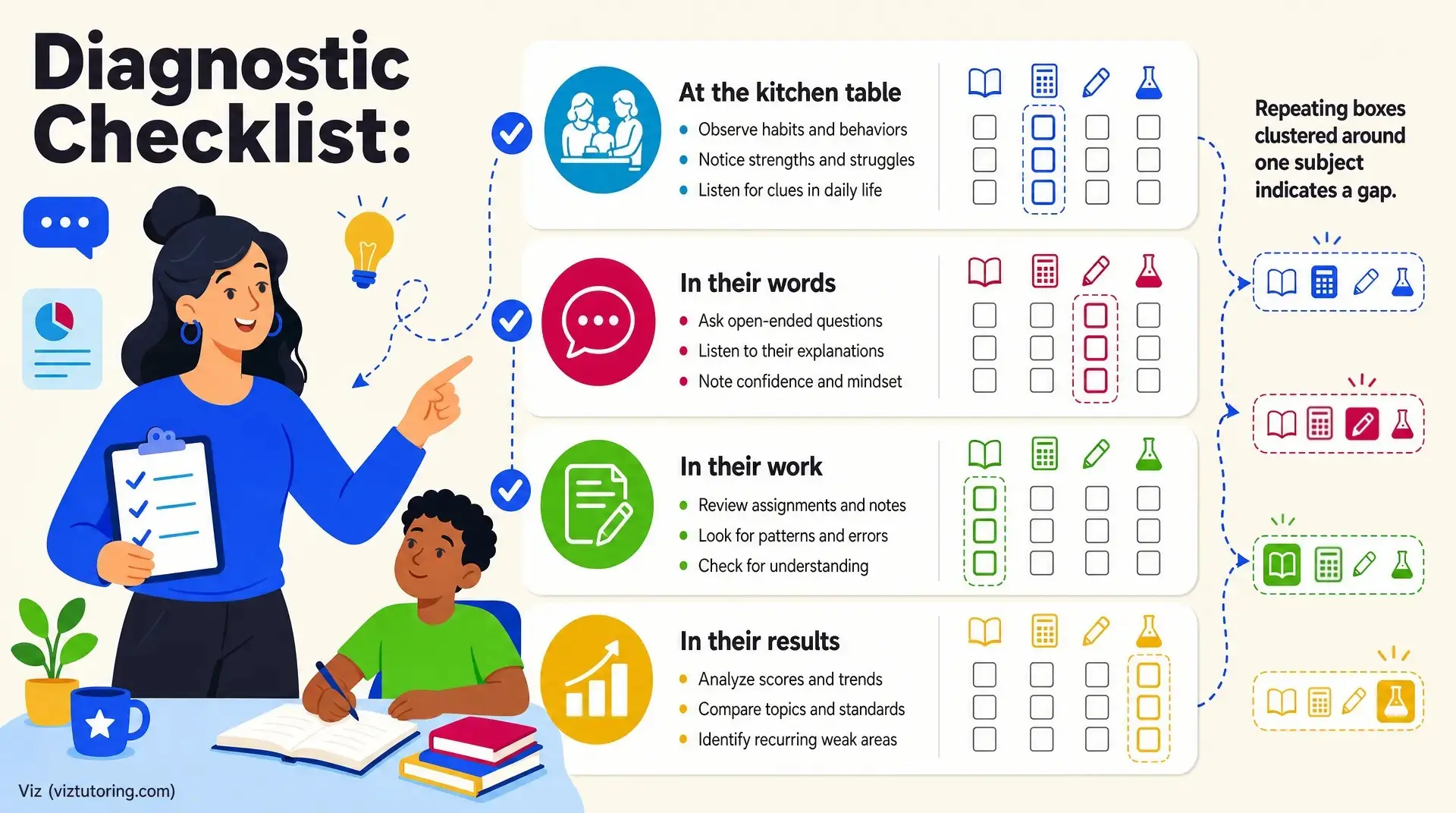
One or two boxes showing up occasionally is a normal season of childhood. Several boxes repeating for weeks, clustered around one subject – from what I’ve seen, that’s a gap. And remember the cohort data from earlier: left alone, gaps sit there or widen.
What Are the Educational Benefits of One-on-One Private Tutoring for Struggling Students?

If you checked several boxes, please hear this clearly: bringing in a tutor is not an admission that you’ve failed. Some of what a tutor provides, you genuinely cannot, no matter how capable you are. It starts with neutrality.
You’re the parent, so homework with you arrives pre-loaded with everything else: dinner, screens, siblings, bedtime. A tutor walks in carrying none of that history. Remember my student from New York – the same child who cried with her parents was calm and willing with me. That neutrality is often what finally lets an adult see what the child actually knows.
Then there’s precision. One-on-one, I can stop, go backwards, and spend an entire session on a single misconception, moving exactly at the student’s pace. No classroom can structurally offer that, and the evidence on what happens when kids get it is remarkably consistent. The Education Endowment Foundation estimates one-to-one tuition delivers about five additional months of progress on average.
This is also exactly why I built Viz the way I did. Our tutors are trained never to simply correct a wrong answer. The student talks through the problem out loud first, because if I jump in too quickly, the problem gets solved, but the student doesn’t gain that understanding. Our matching weighs a child’s actual interests alongside credentials because rapport is what makes a nervous kid willing to try – and it’s the thing parents consistently underestimate. And since confusion doesn’t book itself two weeks in advance, families can grab an on-demand session the night a student gets stuck, with no packages and no lock-in.
Why Should Parents Trust Early Behavioral Signs Over Report Cards for Tutoring Interventions?
You don’t need the report card to confirm what your gut has been telling you for weeks. The report card is the last sign, never the first.
Your job isn’t to figure out whether it’s a skill gap, anxiety, or the two feeding each other. That’s what people like me are for. Your job is simply to notice. And if you’ve read this far, I suspect you already have.
Frequently Asked Questions
How often does my child need to meet with a tutor to see real academic progress?
Consistency beats duration every time. The Education Endowment Foundation notes that short, regular sessions three to five times a week deliver optimal impact. Shorter check-ins prevent cognitive overload while steadily rewiring a student’s confidence over a 10-week period.
Should I try to tutor my own child before paying for professional help?
I strongly advise against it. The emotional weight of parenting makes objective teaching incredibly difficult. A 2020 NBER review noted that professional educators are significantly more effective than parents at tutoring. Your child needs a neutral, patient mentor, not another tense dynamic at the kitchen table.
Will AI homework apps or chatbots help fix my child’s learning gaps?
No, because AI fundamentally lacks empathy. Apps provide instant answers but cannot rebuild a shattered academic identity. OECD PISA 2022 results confirm that strong student-teacher relationships significantly reduce math anxiety. Struggling students require human connection and emotional safety to finally feel comfortable asking vulnerable questions.
Is tutoring more effective for elementary students or older teenagers?
It is effective for both, but intervening early yields the highest return. The Education Endowment Foundation found one-on-one support produces about six additional months of progress in primary school, versus four months in secondary. Fixing foundational gaps early prevents them from compounding into severe high school anxiety.
What if my child only experiences academic panic right before major tests?
Sudden panic is often a symptom of quiet, unaddressed confusion that finally hits a deadline. Traditional centers with rigid contracts cannot help at 8:00 PM on a Tuesday. In these moments, you need an on-demand, vetted academic safety net to de-escalate anxiety, pinpoint the misunderstanding, and restore peace.