

The child in tears over an assignment is often the hardest worker in the room, straining through basic arithmetic and cramped calculations simply to keep pace. Urging them to try harder hurts the student already giving everything. That difficult worksheet merely reveals a missing puzzle piece from past grades, and how a preteen handles fractions dictates their future math outcomes.
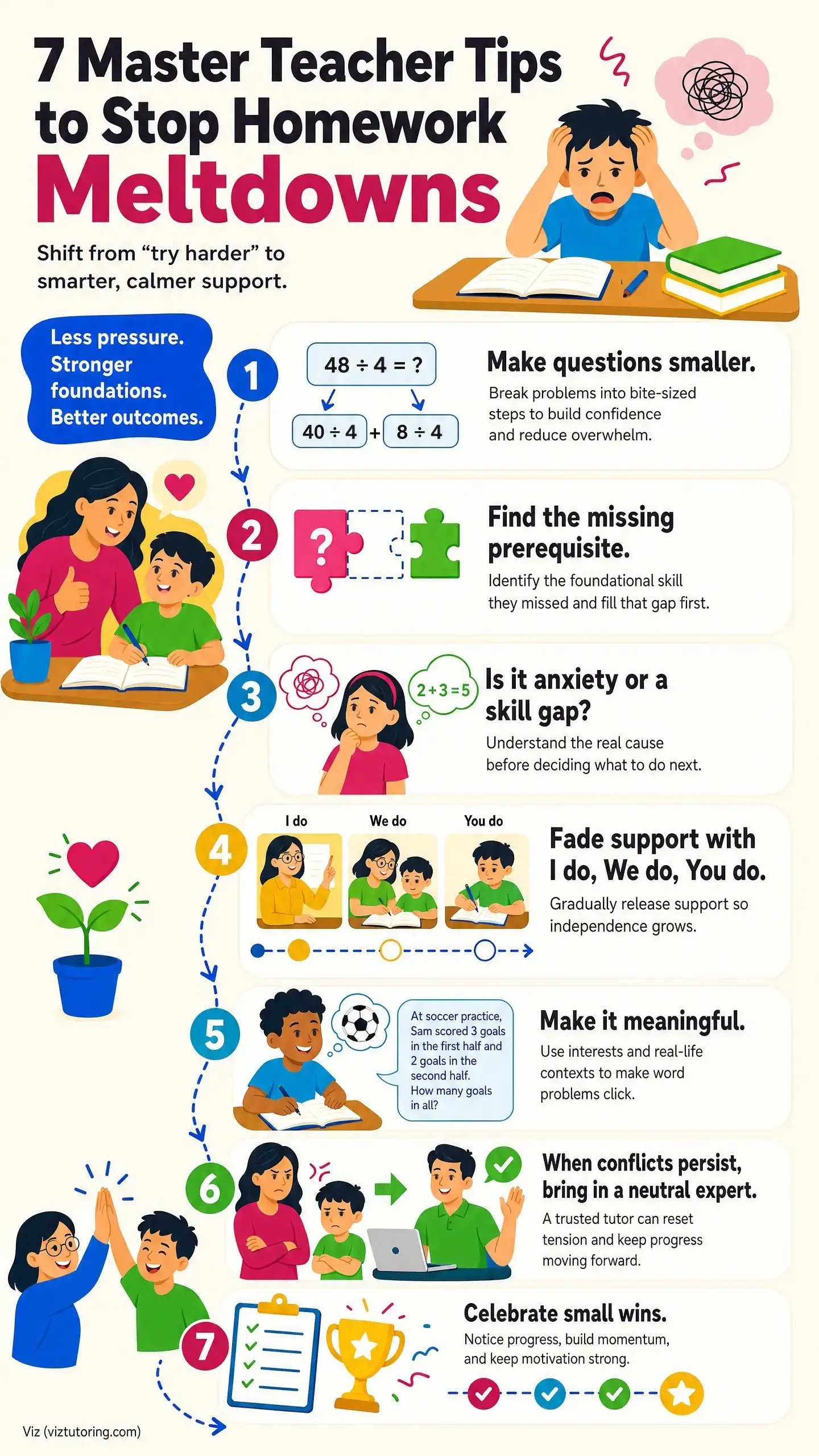
Key Takeaways
- A 2023 meta-analysis of 63 studies involving nearly 98,000 students found that growth-mindset interventions had, at most, a very small effect on academic achievement, suggesting that encouragement alone shouldn’t be relied on to improve academic outcomes.
- Children’s knowledge of fractions and division in late elementary school predicts their algebra and overall math achievement five to six years later, even after accounting for factors such as intelligence, working memory, other math skills, and family background.
- High math anxiety actively shrinks a student’s working memory, creating cognitive delays and procedural errors that mimic foundational skill gaps even when the underlying mathematical knowledge is present.
- When algebra word problems are personalized to match kids’ interests outside of school, students achieve meaningful learning gains, especially in tricky areas like creating equations from word scenarios.
- When math-anxious parents frequently assist with homework, field studies show their first- and second-grade children learn significantly less math across the academic year and develop higher levels of math anxiety.
- When homework consistently takes longer than expected, more time isn’t necessarily the answer. It can be a sign that a child needs clearer explanations, targeted support, or a different approach to understanding the material.
Why Should Parents Stop Telling Children to Try Harder During Homework Meltdowns?

Parents say this constantly, and to be honest, there were moments in my own classroom when I wanted to say it too. But think about what a child actually hears. They’ve been staring at the same problem for 20 minutes. They’re close to tears. You say, “Come on. You can do hard things. Keep trying!” You mean it as encouragement. What they often hear is: you would be able to do this if you were just trying hard enough. Now they’re frustrated with the math and feeling blamed for being frustrated.
This is where I part ways with how “growth mindset” gets used at kitchen tables. I love the underlying idea. It was never supposed to mean push through no matter what. The research is humbling here too: a 2023 meta-analysis of 63 studies and nearly 98,000 students found growth-mindset interventions had a tiny average effect on achievement, and even that disappeared in the highest-quality studies. Belief alone doesn’t close a gap.
When a child is stuck, I stop caring about effort and start hunting for the why. Do they not understand the concept? Are they missing a prerequisite skill? Do they know what to do but not where to start? Have they simply worked past the limit of their focus? Each of those needs a completely different response, and “try harder” answers none of them.
So I ask something else. “Show me the exact point where this stopped making sense.” Or, “What’s the first step?” Those questions turn the moment from a demand for more effort into actual problem solving. Repeating the same unsuccessful approach while a child gets more and more upset isn’t perseverance. It’s just being stuck, and staying in that loop.
How Can Parents Reduce Homework Meltdowns by Making Assignment Questions Smaller?
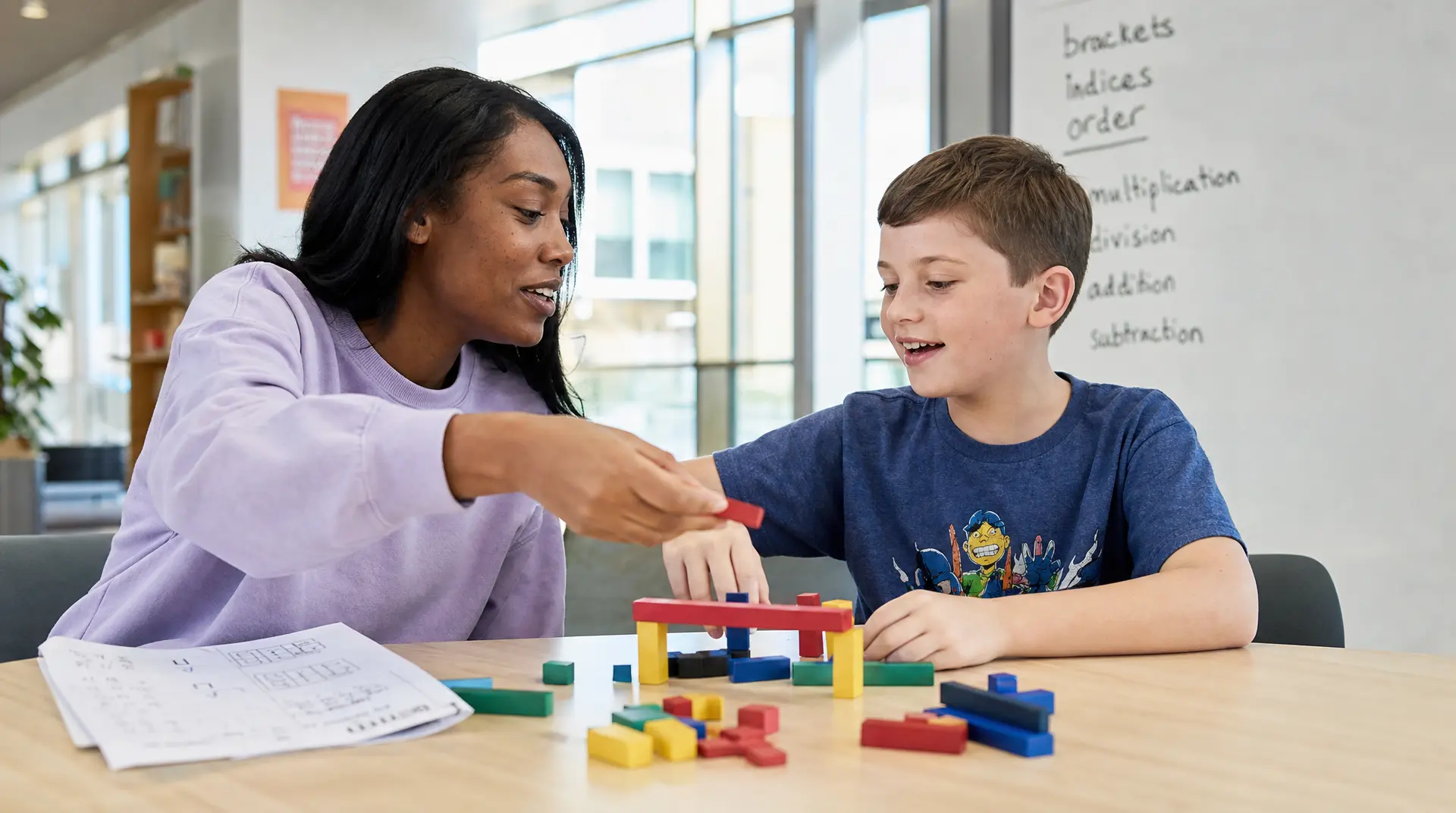
A Grade 5 student of mine would hit a wall and announce, “I don’t know how to do this. I don’t know where to start.” Sometimes on questions she had gotten right the week before. In that moment, frustration had simply taken over. Pushing her to attempt the same question again would have confirmed her worst suspicion: that she was failing at something she was supposed to know.
So I changed the task completely. Grade-level question aside, manipulatives out, back to a concrete version of the same concept. All of a sudden I could find the point where she did understand, and from there we built forward slowly.
Most parents in a meltdown ask themselves, “How do I get them to finish this question?” I’d reframe that into a better one: “How can I make this a smaller question, something they can actually achieve tonight?” Cover part of the problem with your hand so they’re not staring at one long block of text. Swap in smaller numbers. Draw it. Grab objects from around the house. Or ask them to explain only the first step and nothing more.
None of this lowers the bar. Concrete and visual representations are one of only six practices the What Works Clearinghouse rates as strongly evidence-backed for elementary math. Sometimes the fastest, most productive way forward academically is actually to go backwards for a few minutes. Once a child experiences, “okay, I do understand this part,” they have solid ground to stand on, and that lands very differently than being told to keep trying.
How Can Parents Identify Missing Prerequisite Skills Assumed by Homework Worksheets?
When the same fight keeps happening, most families ask why the child won’t do the work. In my experience, the more useful question is this: what does this assignment assume my child already knows?
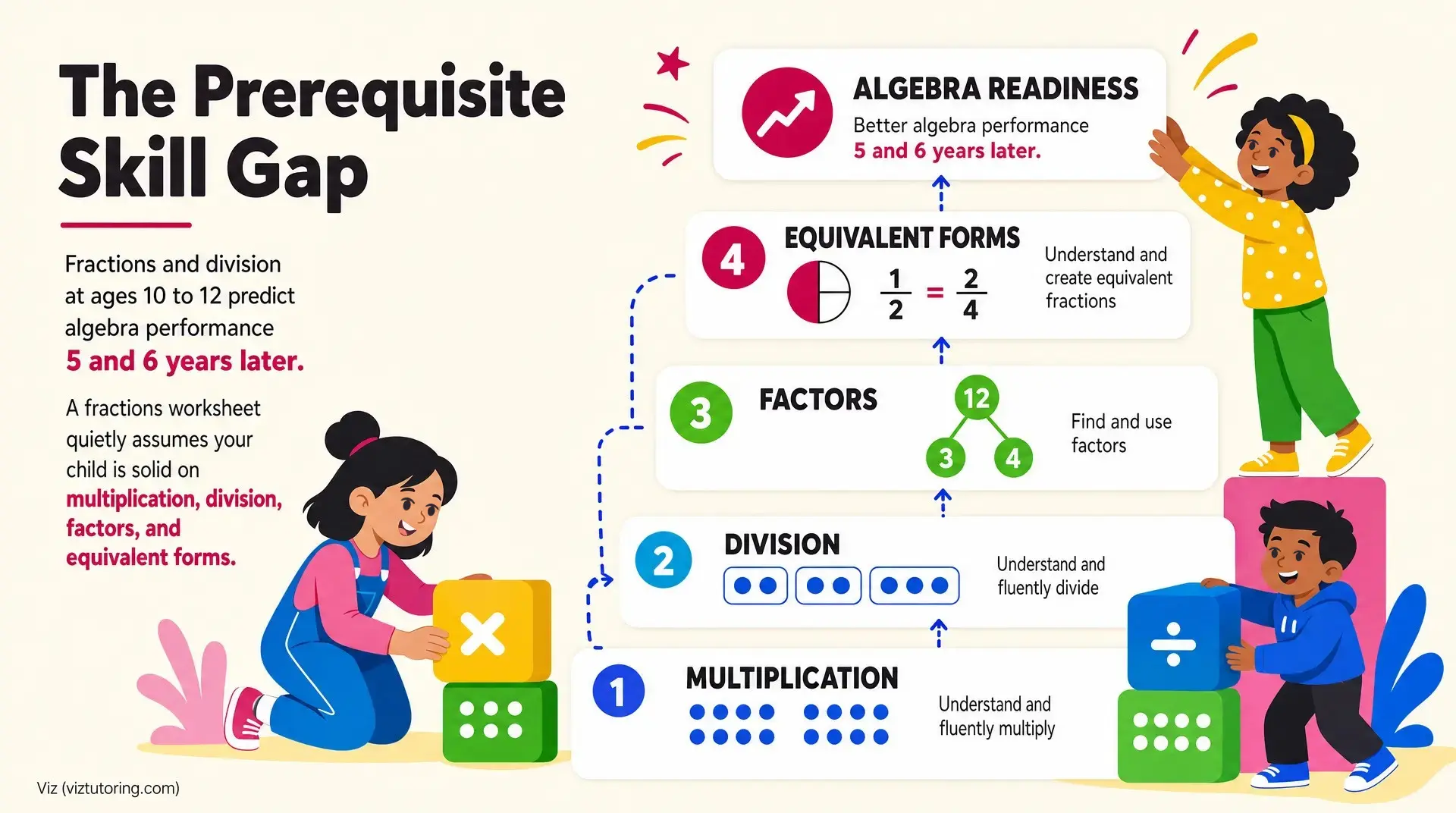
Fractions are my favourite example, because after years of teaching Grade 5, I can tell you fractions were usually the point where the problem became visible, even though they were almost never where it started. A fractions worksheet quietly assumes your child is solid on multiplication, division, factors, and equivalent forms. A kid who can’t find a common denominator often never fully learned their multiples two grades ago. The worksheet is just where that finally surfaced.
And these particular foundations carry more weight than most parents realize. One large longitudinal study followed thousands of students in the U.S. and U.K. and found that a child’s grasp of fractions and division at ages 10 to 12 predicted their algebra performance 5 and 6 years later, even after accounting for intelligence, working memory, and family income.
So I watch for small signs of overcompensation like finger counting or margins crowded with tiny calculations for math that should be automatic by now. Those workarounds mean a child is quietly doing double the work just to keep up. I really try to understand what a child actually knows before assuming their frustration means they don’t care.
How Can Parents Distinguish Between Math Anxiety and Foundational Skill Gaps?
From the outside these look identical. Pencil thrown down, tears falling, “I can’t do this.” Underneath, they behave very differently, and I tell them apart by changing one thing at a time.
Anxiety makes performance fluctuate. The child gets questions right one night, falls apart the next, and does fine the moment nothing is at stake. A foundational gap shows up repeatedly, in a recognizable pattern, the same type of error on the same type of question no matter how calm they are. So I remove the pressure. No timer, an easier version of the same topic, and I ask the child to talk me through their thinking out loud. A student who presents a lack of confidence often knows much more than they initially show. A student with a true gap hits the same wall in the same place, gently and consistently.
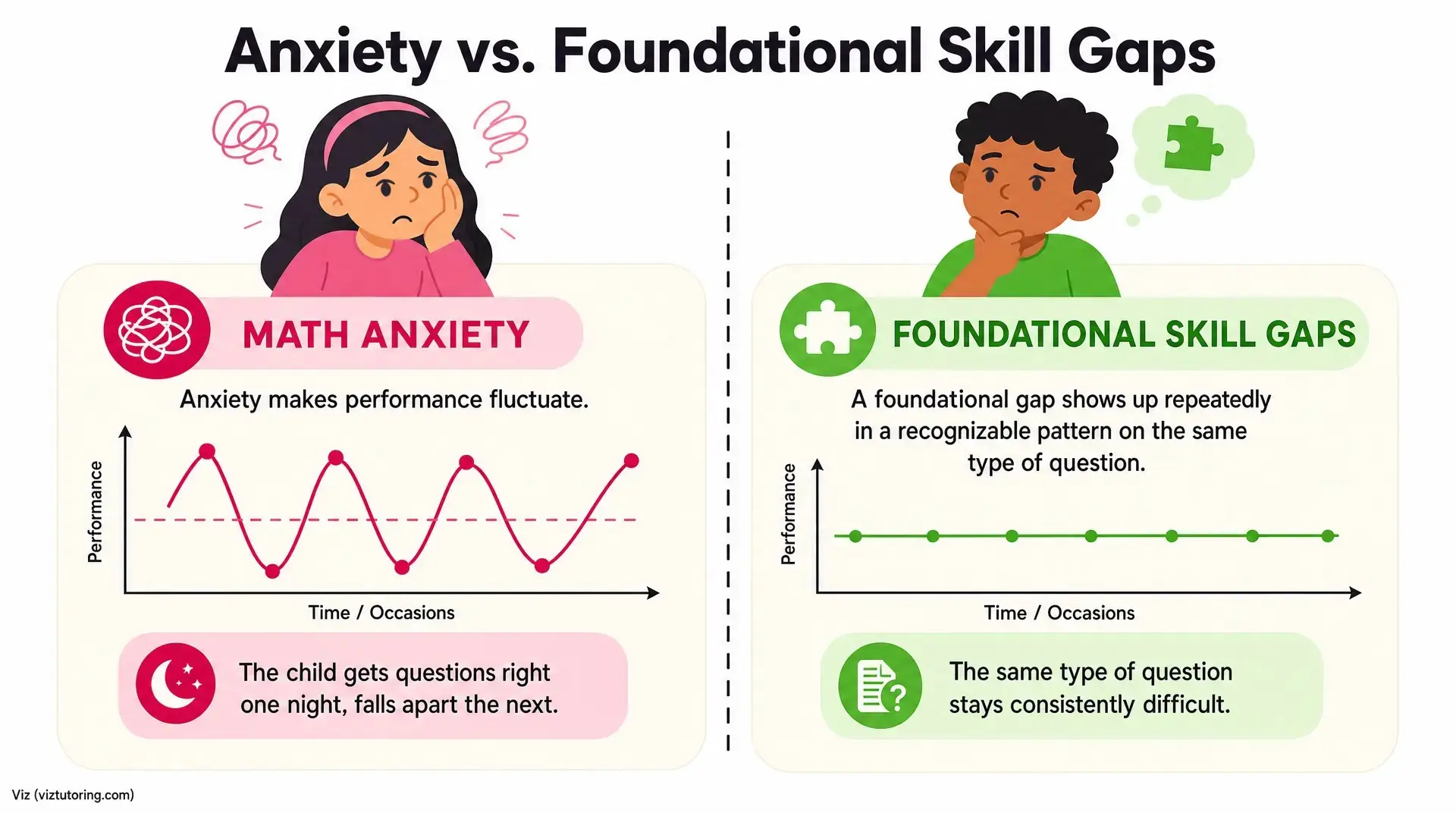
I take the anxiety side seriously because I lived it. I was a quiet, mostly-A student through Grade 8, and my grades dropped in high school because I struggled with test-taking and memorizing formulas. Lab research backs up what that felt like: high math anxiety shrinks working memory, producing exactly the delays and errors that make a child look less capable than they are. Across OECD countries, 30% of 15-year-olds say they feel helpless doing a math problem. Your child is not uniquely broken.
One warning. These two feed each other. Children can develop anxiety because they’ve been working around a skill gap for months, and by the time an adult notices the anxiety, the two are already tangled together. Reassurance can’t fix a gap, and drilling can’t fix anxiety, so it’s worth 10 quiet minutes of observation before you pick your treatment.
Why Dropping the Difficulty Level and Stepping Back Helps with Homework
Two habits actually close gaps for good, and both feel wrong to parents at first.
The first is dropping below grade level deliberately. When a student is drowning in fractions, I don’t stay in fractions. I go back to plain multiplication and division, then reintroduce fractions visually, through word problems the child can picture. It’s slower, and sometimes it’s okay if a student is behind curriculum, because they need that time to be caught up. Skipping this step is how kids arrive in Grade 8 still hiding a Grade 4 hole.
The second is resisting the rescue. If I jump in too quickly, the problem gets solved, but the student doesn’t gain the understanding. Worse, too much help quietly teaches a child they can’t do it alone. My own Grade 9 math teacher was the perfect cautionary tale. He’d walk around during tests, point at the exact spot in the question, murmur, “are you sure?” whenever someone drifted off track. Everyone in that class got great grades. I left it knowing tricks for his specific problems and barely any actual math.
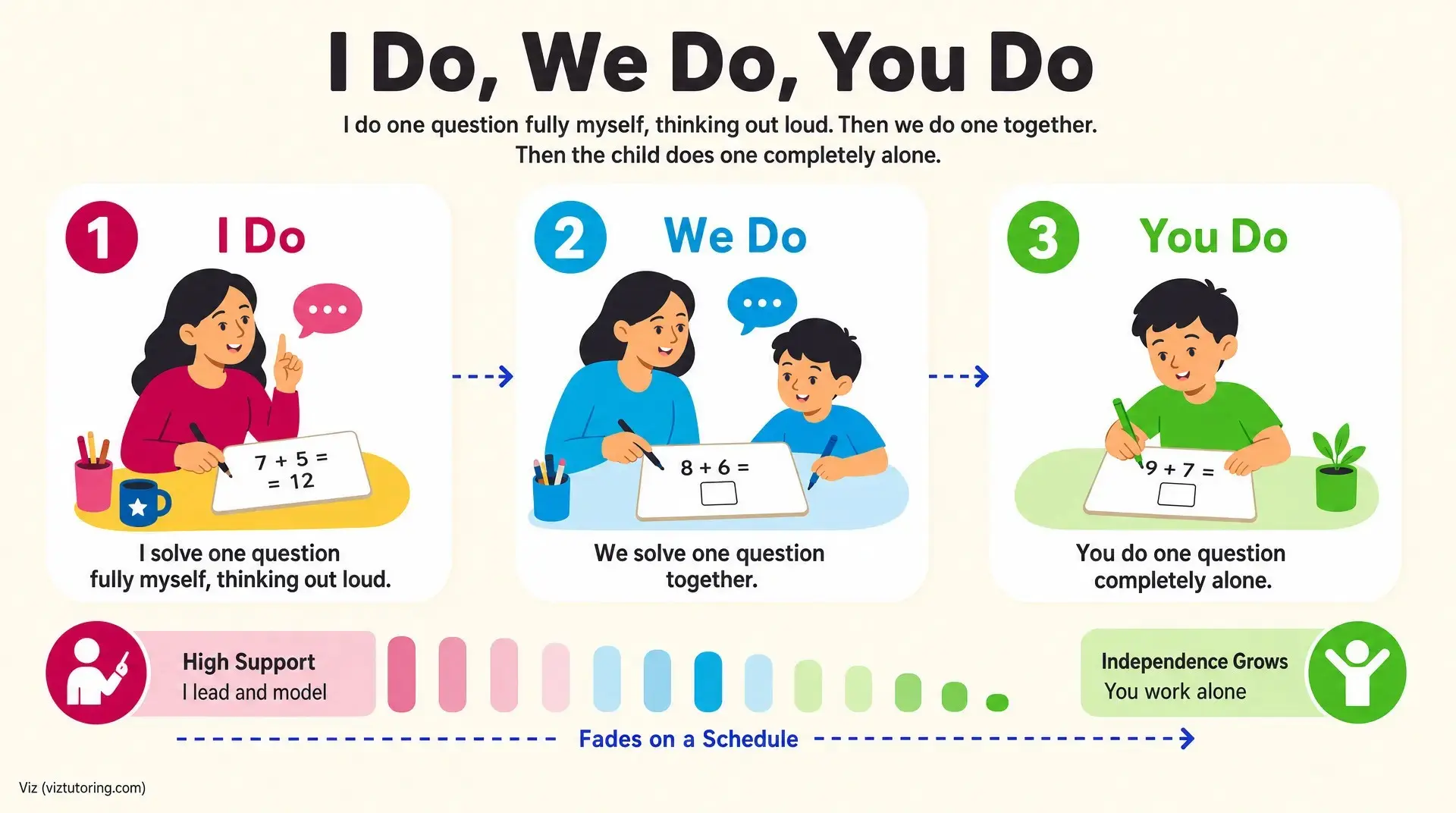
The structure I use instead is simple enough for any kitchen table. I do one question fully myself, thinking out loud the whole way. Then we do one together. Then the child does one completely alone. I scale back help progressively so confidence builds naturally.
How Does Personalizing Homework Problems Around a Child’s Interests Improve Academic Engagement?
“I’m just not a math person.” “I’m not a writer.” I’ve heard these hundreds of times, and I’ve never dismantled the belief with a pep talk. I dismantle it by changing what’s on the page.
When a fourth-grade boy who hated writing, but showed a love for hockey, I had him write about a day in the life of a hockey puck. He wrote about the puck’s feelings during a slap shot, the noise of the crowd, being stolen from one team by the other. Parts of it genuinely made me laugh, and a kid who “wasn’t a writer” couldn’t wait to keep going. Another student, a Grade 5 girl who dreaded math, lit up when I built word problems around her gymnastics and showed the numbers using dots and virtual manipulatives.
You can do this at home with zero training. Take tonight’s problem and reword it around their world. For a kid who loves gardening: a flower is 10 centimeters tall and grew 2 centimeters last week, so how tall was it before? Same math problem, but a totally different outlook. According to a randomized algebra study, adapting story problems to students’ personal interests delivered its strongest outcomes on the hardest skill, writing equations from scenarios, and significantly helped struggling students.
Schools mostly can’t do this, and I say that as someone who has taught in three countries. With 25 or 30 kids and an hour of class, a teacher has roughly two minutes per student. The limitation is the classroom model itself, not the people working inside it. At home, with one child across the table, you hold a personalization advantage no classroom has ever had.
When Should Parents Hire a Neutral Third-Party Tutor for Homework Help?

Nearly all of us are on the front line here. 95.5% of U.S. elementary students who do homework outside of school get help from a parent at least occasionally. But almost no parent is a neutral party. You’re the person whose opinion your child cares about most, which makes every wrong answer feel heavier at your table than it ever would with a stranger.
There’s a sharper problem if math made you anxious as a kid. One field study found that when math-anxious parents frequently helped with math homework, their first- and second-graders learned less math across the year and developed more math anxiety themselves. The anxiety travels through the helping.
Three signals tell me a fight has outgrown a bad night. The battle keeps returning to the same subject. Twenty minutes of homework routinely stretches past an hour. This matters more than parents realize. The classic homework meta-analysis reveals that more parent-reported elementary school homework time actually tracked with slightly worse achievement. Long nights usually signal struggle, not productive persistence. And then the identity claims arrive: shutting down, or announcing “I’m bad at math.”
When those show up, bring in a neutral third party. A tutor, a teacher offering extra help, a calm relative. The emotion drains out while the actual gap gets rebuilt. This is honestly the biggest reason I built Viz the way I did, with on-demand sessions for the 9 p.m. panic before a test and matching that weighs a child’s interests as heavily as a tutor’s credentials, because shared interests are the factor parents really, really underestimate. Whoever you choose, the goal is the same: get the fight out of your relationship so dinner can go back to being dinner.
What Support Systems Can Parents Use to Resolve Persistent Homework Conflicts?
I always want a child to learn that they can get better at things that are difficult. But the second half of that message matters just as much: they don’t have to figure out everything by themselves.
Parents deserve the same two sentences. You can get better at these homework nights. And you don’t have to solve them alone at 9 p.m., with a crying child and a worksheet built on methods you haven’t seen in 20 years.
So next time the pencil goes down, skip “try harder.” Make the question smaller. Ask what the worksheet assumes. Watch whether the errors fluctuate or repeat. Go backwards on purpose, model instead of rescuing, put their hobbies inside the problems, and step out of the ring when the pattern tells you to. The fight was pointing at a cause the whole time. Find the cause, and the fighting takes care of itself.
Frequently Asked Questions
Will forcing my elementary child to study longer improve their grades?
Drilling longer fails. A major meta-analysis proves time spent and elementary achievement has zero correlation. More time actually signals your child is struggling, not succeeding. Stop the clock, find the foundational gap, and protect your evening.
How can I help with math homework if I have math anxiety myself?
Step back. A field study shows when math-anxious parents help, their children learn less and develop anxiety themselves. The stress travels through the helping. Bring in a neutral third-party tutor so the emotion drains out while the academic gap gets successfully rebuilt.
Should I correct all my child’s homework mistakes before they turn it in?
Resist the rescue. If you constantly intervene to fix every error before submission, your child quietly learns they cannot succeed alone. Furthermore, teachers need to see those mistakes to identify hidden prerequisite gaps. Support them by doing one problem together, but then sit on your hands so their true understanding becomes visible.
Is it normal for my high schooler to spend hours on assignments every night?
Yes, expectations jump. In 2019, U.S. secondary students averaged 7.5 hours weekly outside school. Unlike elementary grades, this time correlates with higher achievement. However, if they consistently exceed this average and show signs of extreme frustration, they might be masking a hidden skill gap.
What should I do when my child completely shuts down late at night?
Close the book. When late-night fatigue sets in, a child reaches the absolute limit of their focus. Pushing forward only tangles the academic gap with severe anxiety. Write a brief note to the teacher explaining exactly where they got stuck, step out of the ring, and let dinner go back to being dinner.