
A machine that does exactly what it’s told is worthless to a child who doesn’t still know what to ask.
A teenager who says “I don’t understand anything” is almost never lost on the worksheet in front of them. The real gap sits two units back, in something no one thought to check. The machine solves every problem on that page flawlessly and never once wonders why the child can’t.
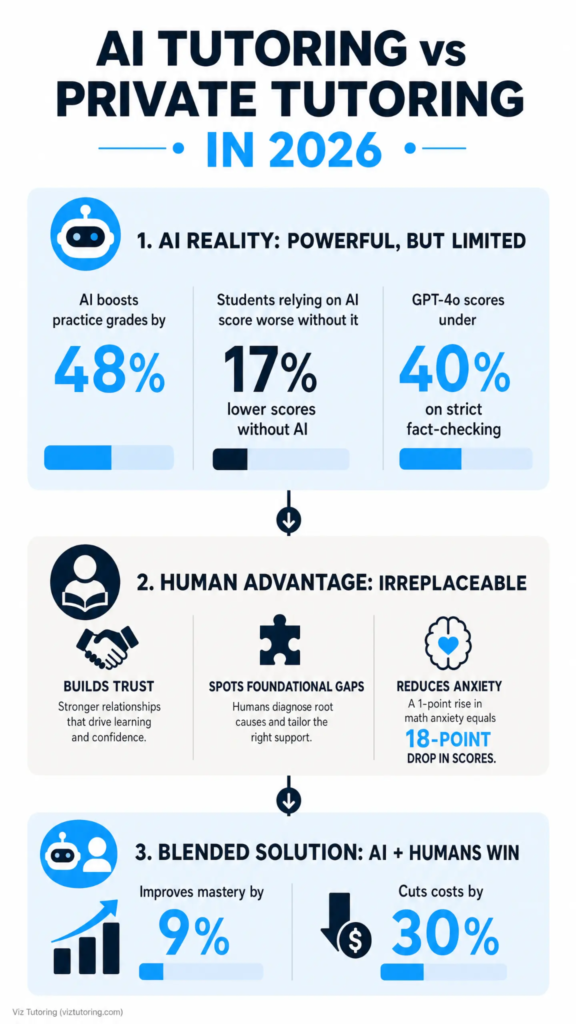
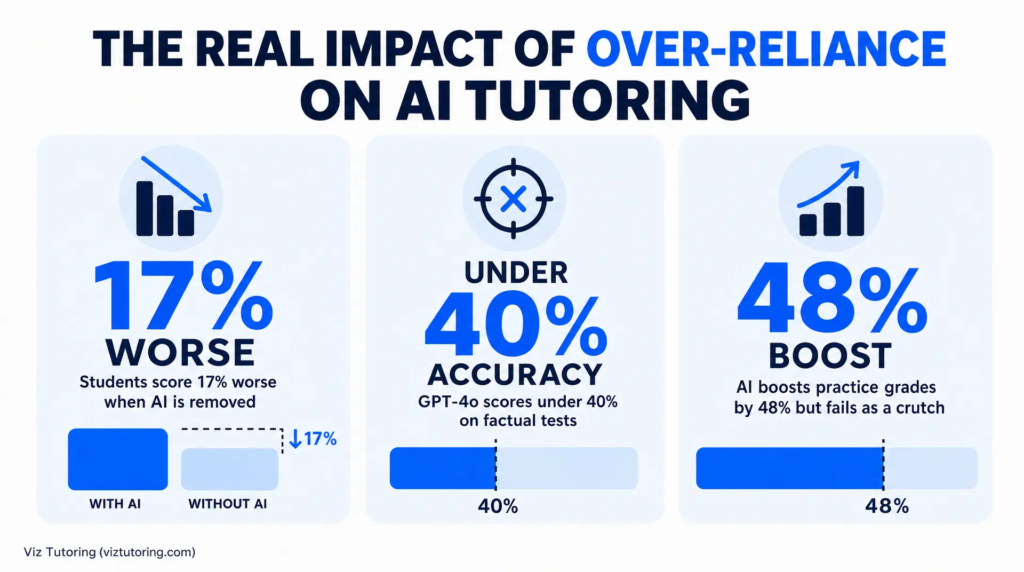
Take it away and those same students score 17% worse than the ones who never used it. The flawless answer quietly dismantled the skill it was meant to build.
Key Takeaways
- High school students relying entirely on artificial intelligence chatbots for math practice scored 17% worse on subsequent assessments when the technology was removed compared to students who never used it.
- On strict fact-checking evaluations, top artificial intelligence models like GPT-4o score under 40%, demonstrating that chatbots cannot act as reliable academic authorities for high-stakes coursework.
- Following a proven Chicago educational model, successful human tutors spend half of every session diagnosing and teaching unmastered earlier-grade material that AI chatbots completely skip.
- Organization for Economic Co-operation and Development data reveals that each one-point increase in student math anxiety causes an 18-point drop in math scores, a spiraling effect that requires human empathy to mitigate.
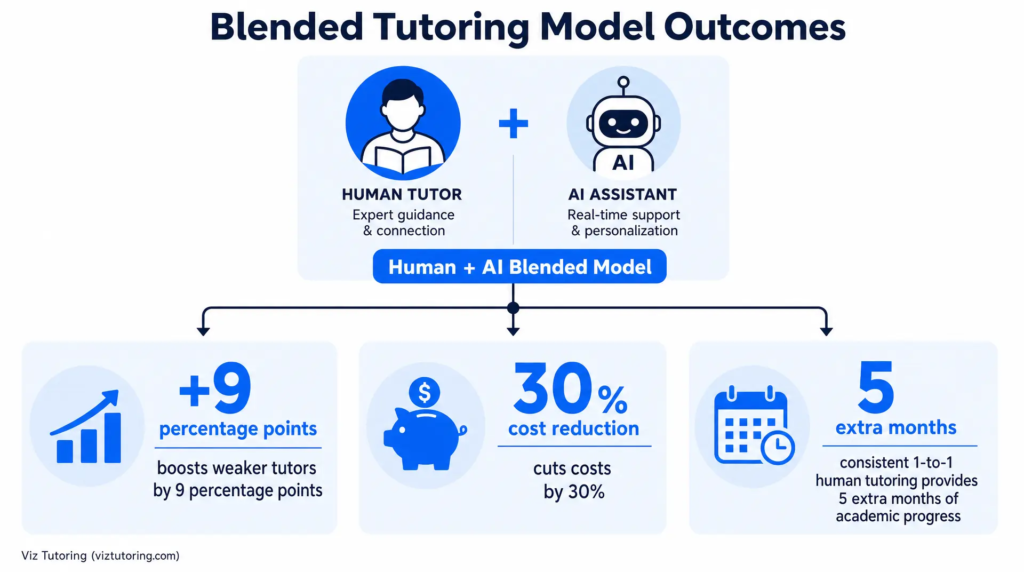
- Blended tutoring models that pair human educators with artificial intelligence assistants reduce program costs by 30% while improving the effectiveness of weaker tutors by nine percentage points.
- Consistent one-to-one human tutoring delivered in short, regular sessions generates approximately five extra months of academic progress for students by building trust and diagnosing foundational gaps.
Will AI Completely Replace Human High School Tutors in 2026?
There’s a loud belief out there. That AI will completely take over high school tutoring. That by 2026, nobody pays for a human when a chatbot answers any question, instantly, for free.
I get the appeal. You’re running a packed family schedule and a real budget. Your teenager’s grades suddenly feel like they carry the weight of a university acceptance. If a free app can do the job, of course you’ll look at it.
And AI is already everywhere. Stanford’s latest research shows that four out of five students now use AI for schoolwork. A Pew survey found that 54% of U.S. teens have used chatbots for school, and 59% say kids at their school use AI to cheat at least sometimes. This isn’t coming. It’s here.
So here’s my honest take. Not a sales pitch. The real thing, from someone who taught in a classroom, worked as a tutor, and now runs a tutoring company.
I’m not anti-AI. We use technology every day at Viz to make good tutoring faster and easier to reach. But parents who think AI replaces a great human tutor are misunderstanding what a great tutor actually does.
What Are the Benefits and Limitations of AI Chatbots in Student Tutoring?
I won’t pretend AI is useless. That would be dishonest.
AI genuinely does some things well. If your son panics the night before a math test and drops his review sheet into a chatbot, it walks him through the problems. It shows the solutions. It hands him the formulas he forgot. One study of nearly a thousand high school math students found a standard chatbot boosted their practice grades by 48%. Another found chatbot math help could match human-written hints in certain problems.
So use it. Treat it as a study aid.
You just can’t treat it as a reliable authority. On a straight fact-checking test, a top model like GPT-4o scored under 40%. It sounds confident even when it’s wrong. And there’s a wall it hits that matters enormously the moment the stakes go up.
Why Do AI Tutors Fail to Identify Foundational Learning Gaps in Students?
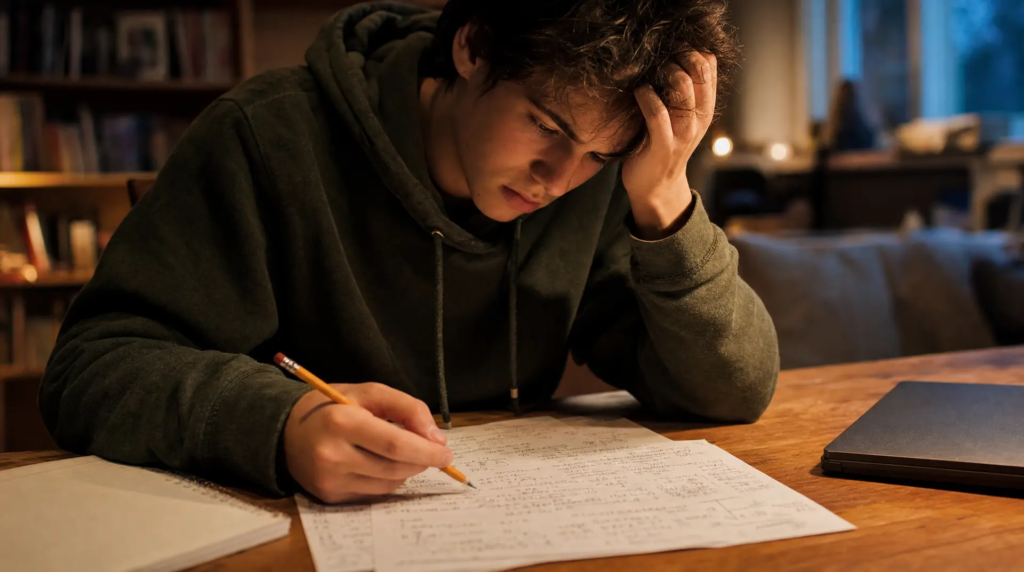
Here’s a pattern I watch play out over and over with last-minute students.
A kid books a session right before a test. They say the same thing almost word for word. “I don’t understand anything. I don’t know where to start.” They’ve got their unit review sheet in hand, and they’re stressed out of their minds.
Now think about what AI would do here. It does exactly what it’s built for. It marches through that review sheet, question by question, showing the solution to each one. Neat, tidy, technically correct.
But here’s the thing that keeps me in this business. When a student says “I don’t understand anything,” they are almost never missing what’s on the review sheet. They’re missing something underneath it. A core idea from two units ago that everything else is quietly built on top of.
A good human tutor spots this in minutes. AI won’t. AI is answering the questions right in front of it. It has no reason to go digging for a missing foundation that was never printed on the practice test.
That same study proved the danger of leaning too hard on the machine. When researchers took the AI away, those students scored 17% worse than kids who never used it at all. The chatbot became a crutch. It handed over answers without ever building real skill.
The tutoring programs that get results go hunting for those gaps on purpose. In one well-known model in Chicago, half of every session was spent on earlier-grade material the student had never mastered. That’s the invisible work. AI skips it entirely.
How Does Human Tutoring Build Conceptual Understanding Versus AI Rote Memorization?

When my tutors describe that missing piece, it comes back to the same thing every time. It really comes down to memorization versus understanding.
Let me make that concrete, because it’s the heart of everything.
A student memorizes that length times width equals area. Hand them two numbers and they’ll give you an answer. But ask them what area actually is, that it’s the space inside two given dimensions, and they freeze. They memorized a trick without ever grasping the thing behind it.
AI is fantastic at reinforcing the trick. It’ll drill that formula all night. What it can’t do is notice that the formula was never the problem.
This isn’t just my opinion. The National Academies describe real math ability as five connected strands, and conceptual understanding sits at the core of all of them. Memorizing a formula covers one narrow strand. It leaves the rest hollow.
That noticing, that diagnosis, is a human act. It’s the tutor beside your child who realizes the real issue isn’t tonight’s test. It’s a gap from last year that nobody caught. Fix the foundation, and the test takes care of itself.
Why Is Human Experience More Valuable Than Academic Credentials in High-Stakes Tutoring?

When parents come to us for the high-stakes subjects, AP Calculus, IB, Organic Chemistry, they very often ask for our most qualified people. Our Level 5 tutors. I completely understand the instinct.
A Level 5 tutor at Viz holds a Master of Education and is a certified teacher. Usually with years of classroom experience and extra courses stacked on top. That’s real. It’s theory paired with the practical mileage of someone who has taught hundreds of students and seen every version of “I don’t get it.” When a parent asks for AP Calculus help, those experienced, subject-specific tutors are the only ones we’ll match that student with. We don’t gamble on that.
But I’ll tell you something I genuinely believe. Credentials can just be table stakes. They can just be letters after a name.
The letters get a tutor in the door. What you’re actually paying a premium for is something you can’t Google.
When a student sits down feeling shut down and frustrated, the great tutor doesn’t only know the calculus cold. They read that frustration. They get to the root of why this kid feels stuck. Is it the material? A foundational gap? Shaky confidence? Pressure from school, from friends, from themselves?
That judgment call, made in real time with an anxious teenager in front of them, is the un-googleable skill. And it keeps growing. A review of 30 studies found teachers keep getting better well into the second and third decade of their careers. Experience compounds. A certificate is frozen the day it’s printed.
The research on who tutors best backs this up. A large meta-analysis found tutoring gains were stronger with trained teachers than with untrained helpers. Who sits in that chair matters. An experienced tutor teaches the content, yes. But they also figure out what’s really causing the stress, connect with the student, and rebuild the confidence that got shaken along the way. That last part is the whole point.
How Do Teacher-Student Trust and Human Empathy Outperform AI in Academic Tutoring?

Here’s the piece I care about most. And it’s the piece that gets ignored in every “AI will replace tutors” headline.
AI doesn’t really have a personality. You prompt it, you ask a question, it hands you an answer. It might even toss out a “good job, you got that right.” But there’s no real conversation. No relationship forming. No trust being built.
Trust is the whole game.
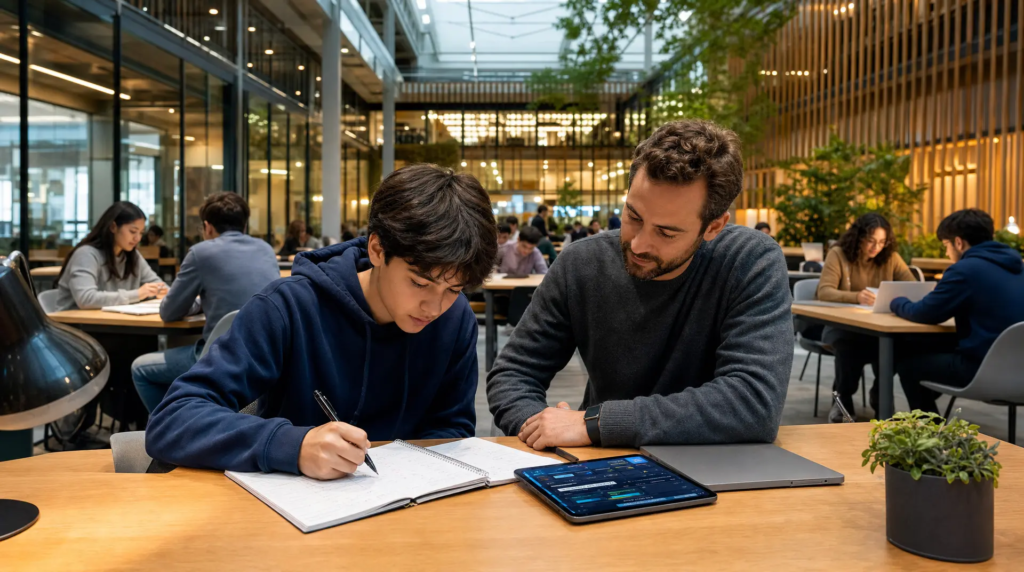
When I look at our most successful matches, they almost never come down to the subject alone. They come down to a tutor asking, “How was your day? How’d the game go this weekend? How was the dance recital?”
Students really start trusting tutors when they remember about their lives. When a tutor recalls the vacation they took, the sport they play, the thing they were nervous about last week. That’s when a kid finally lets their guard down. That’s when they’ll admit, “Honestly, I don’t get any of this.” And that admission is the exact thing you need before you can help them.
Trust isn’t a soft extra here. A meta-analysis of 99 studies tied strong teacher-student relationships directly to higher engagement and better grades. Kids learn from people they trust.
Then there’s the emotion nobody likes to talk about. Fear. Organisation for Economic Co-operation and Development data shows that each one-point rise in math anxiety comes with an 18-point drop in math scores. A panicked kid can’t learn, no matter how clean the explanation. A chatbot can’t feel a student spiraling. A human can, and knows to slow down.
This is why our matching isn’t random. Our algorithm weighs curriculum, learning needs, gender preference, and yes, hobbies and shared interests. The tutor who clicks with your daughter over something they both love is the tutor she’ll actually open up to. An algorithm can congratulate your child. It can’t earn the kind of trust that makes your child honest about what they don’t know.
What Is the Optimal Role of AI in a Blended Human Tutoring Model?
AI has a real role to play. Its best use is backing the human tutor up.
There’s a study I love on this. Researchers gave an AI helper to 900 human tutors working with 1,800 kids. Students whose tutors used the AI were more likely to master topics. And for the weaker tutors, the boost jumped by nine percentage points. The AI made good humans better. The humans still did the teaching.
Blended models like this can also stretch a budget. One randomized study pairing human tutoring with computer-assisted learning cut costs by 30% while keeping strong learning gains. That’s the smart way to use the machine. Let it handle what it’s good at, and keep the human for what only a human can do.
When Should Parents Choose Human Tutors Over AI Assistants in 2026?

Use AI for the quick stuff. Fast answers. Extra practice problems. A formula your kid blanked on. Think of it as a calculator with a friendly voice. Helpful, fast, and completely blind to the bigger picture. It’ll do exactly what you ask and never once wonder why your child is struggling.
But when the stakes are real, a midterm, a university-track course, a kid quietly losing confidence, you want an experienced human in your child’s corner.
This is exactly why we built Viz the way we did. When panic hits before a test, our on-demand feature gets your child in front of a vetted tutor in under 24 hours. Fast, and human. Every tutor clears a rigorous interview, background checks, and our in-house training before they ever sit with a student. That’s what I mean when I say vetted.
For the long game, our scheduled sessions pair your child with the same tutor over time. Continuity is where trust and real progress live. The evidence agrees. One-to-one tutoring delivers about five extra months of progress, and it works best in short, regular sessions. That steady rhythm does more than any single cram session ever could.
If a match doesn’t feel right, you request a re-match at no cost. We never pair your child with a declined tutor again. You shouldn’t pay a premium for a relationship that isn’t clicking.
There’s a quieter benefit too. Sessions replay for 90 days, so your child can revisit exactly how a concept was explained when revision time comes. And you get feedback after each session, so you’re never guessing whether your money is working. When you’re managing your child’s whole academic path, that transparency matters.
Why Are Human Tutors the Best Educational Investment for Students in 2026?

By 2026, AI is everywhere in education, and it should be. It makes a lot of things faster, cheaper, and easier to reach. I welcome all of it.
But it will not replace the person who notices your son has gone quiet. Who remembers he had a big game on Friday. Who gently uncovers that the reason he’s failing this week has nothing to do with this week’s material. It’s a foundation from last year that slipped through the cracks.
You can’t code that. It’s diagnosis, empathy, and trust, delivered by someone who has done it hundreds of times.
Those giraffe essays taught us something worth remembering. AI does exactly what you tell it, without ever wondering why. Your child, especially in these high-stakes years, deserves someone who wonders why. And then knows what to do about it.
That someone is human. In 2026, that’s still the smartest investment you can make in your child’s education.
Frequently Asked Questions
How do I prevent my child from using AI chatbots to cheat on assignments?
It is a valid concern. A Pew survey found 59% of students say peers use AI to cheat. You prevent it through human accountability. A private tutor monitors the strategic thinking process week-by-week, ensuring your child actually internalizes concepts rather than outsourcing the cognitive heavy lifting.
Can we rely entirely on AI tutoring for advanced AP or IB test prep?
Absolutely not. High-stakes subjects require precision, and frontier models like GPT-4o scored under 40% on fact-seeking questions. AI often hallucinates facts confidently. For rigorous AP curriculums, you need Level 5 human tutors with real classroom experience to guarantee accurate, nuanced exam preparation.
What is the measurable ROI of private human tutoring versus free AI apps?
The ROI is definitive academic progress. While AI provides quick fixes, the Education Endowment Foundation shows one-to-one tuition yields five extra months of progress. AI acts as a crutch. Structured human tutoring actively repairs foundational gaps, directly translating to higher grades and university readiness.
Are there hidden data or safety risks when teenagers use AI study tools?
Yes, security is a real issue. The OWASP 2025 report ranks Prompt Injection as the top AI risk, where malicious PDFs override safety guardrails. Private tutoring within a custom, secure ecosystem ensures your child’s learning environment remains strictly vetted and entirely protected.
How often should we schedule private tutoring to avoid the ‘AI crutch’ effect?
Consistency is everything. Research shows students relying solely on AI scored 17% worse on unassisted exams when the tool was removed. To build true mastery, evidence suggests short, regular human sessions – about 30 to 50 minutes, several times a week – keep students accountable and firmly prevent superficial memorization.